Postpartum Depression in Dads: What the Research Says and Why Nobody Talks About It
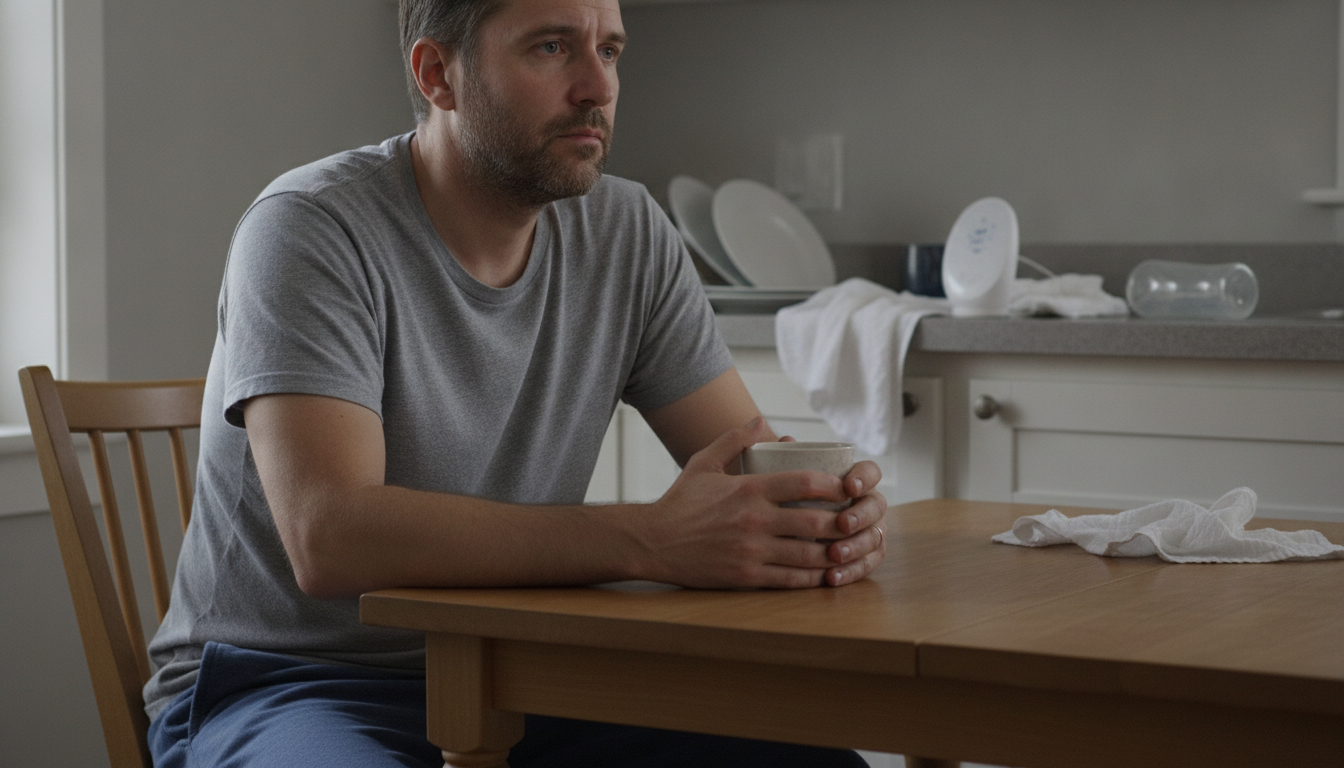
Postpartum depression in fathers is not a fringe concept or a soft rebranding of ordinary stress. It is a clinically documented condition that affects a meaningful percentage of new dads, and the research has been building for over two decades. We almost never talk about it, and that silence has real consequences for the dads going through it, for their partners, and for their kids.
The goal here is not to compete with maternal postpartum depression or to minimize what mothers go through. It is simply to put the data on the table and let it speak. If you are a new dad who has been feeling wrong in ways you cannot name, this one is for you.
The Numbers Are Not Small
One of the most widely cited reviews on the subject, a meta-analysis by Paulson and Bazemore published in JAMA, pooled 43 studies involving more than 28,000 participants and found that approximately 10.4 percent of fathers experience depression in the stretch between their partner’s first trimester and their child’s first birthday, with rates peaking at about 25.6 percent when the baby is three to six months old (Paulson & Bazemore, 2010). An earlier review of 20 studies found that among men whose partners had postpartum depression, rates of paternal depression ranged from 24 to 50 percent (Goodman, 2004). One in ten is not a rounding error. That is a public health reality that most of the public has never heard.
Individual estimates move around depending on the screening tools used and the populations studied, which tells us more about how we measure and who we ask than about whether the condition exists. A 2011 study in Pediatrics of 1,746 fathers of one-year-olds found that about 7 percent met criteria for depression, and those fathers were more likely to report spanking their child and less likely to read to them regularly (Davis et al., 2011). Because that study captured a single point in time, it shows an association rather than proof that depression caused those behaviors, but the authors still concluded that pediatric providers should consider screening fathers. The condition exists. The question is why we keep acting like it does not.
What Postpartum Depression in Fathers Actually Looks Like
Here is where paternal postnatal depression gets tricky to identify. The symptom profile in fathers often does not look like the tearful, withdrawn presentation most people associate with postpartum depression. Dads are more likely to present with irritability, anger, emotional numbness, and behavioral changes like increased alcohol use, overworking, or withdrawing into screens. These are not character flaws. They are recognized symptoms of a depressive episode filtered through the ways men have been socialized to process and externalize distress.
The clinical picture can also include difficulty bonding with the baby, intrusive thoughts, anxiety that runs hotter than the situation warrants, and a pervasive sense of being trapped or like the version of yourself you used to know has simply left the building. That last one is worth sitting with. If you have read our piece on the new dad identity crisis, you already know that a destabilized sense of self is incredibly common in early fatherhood. Postpartum depression takes that normal disorientation and amplifies it into something much harder to climb out of on your own.
The Irritability Problem
Irritability deserves its own mention because it is the symptom most likely to get misread by everyone in the room, including the dad himself. When a new mother is weeping and cannot get out of bed, the people around her tend to recognize that something is wrong. When a new father is snapping at his partner, picking fights over nothing, and seems perpetually on edge, the people around him tend to conclude that he is being difficult. He may conclude the same thing about himself. Neither interpretation leads to help.
The DSM diagnostic criteria for a major depressive episode in adults require either depressed mood or a loss of interest or pleasure in nearly all activities, which means a dad who never once describes himself as sad may still meet the clinical threshold through that loss of interest alone (American Psychiatric Association, 2022). Irritability only formally substitutes for depressed mood in children and adolescents, but in adult men it often rides along with the other symptoms and can be the most visible one to everyone else. This is not semantic flexibility. It reflects a genuine difference in how depression can manifest, and it matters enormously for whether fathers get accurately screened and whether they seek help at all.
Why Nobody Talks About Postpartum Depression in Fathers
The silence around postpartum depression in fathers is not accidental. It is structural. The entire apparatus of perinatal care, from OB appointments to lactation consultants to well-baby visits, is organized around the mother-infant dyad. Fathers are often physically present in that system but functionally invisible to it. Nobody hands dad a screening questionnaire. Nobody asks how dad is sleeping, how dad is feeling about himself, or whether dad has been drinking more than usual.
There is also a cultural script that casts fatherhood as an uncomplicated upgrade. You get a kid, you are supposed to feel grateful and competent and steady. Admitting that you are struggling contradicts that script, and contradicting that script can feel like failing at the one job you are not supposed to fail at. So dads stay quiet. They perform okay-ness. They wait for it to pass. Sometimes it does. Sometimes it calcifies into something much harder to address years down the line.
The Stigma Load
Men in general carry a heavier stigma burden around mental health help-seeking than women do, and new fathers carry an extra layer on top of that. Seeking help can feel like admitting inadequacy at the exact moment when you are supposed to be proving your capability as a provider and protector. Research on men’s help-seeking has repeatedly found that men are less likely than women to seek professional help for problems like depression (Addis & Mahalik, 2003), and in our experience a lot of guys never even get as far as calling what they are feeling depression in the first place.
Add to that the fact that most public conversation about postpartum depression is, understandably, centered on mothers, and you have a situation where a depressed new dad has almost no cultural mirrors. He does not see himself in the PSAs. He does not see himself in the parenting content. He either concludes that what he is experiencing is not real, or he concludes that it is real but uniquely shameful because only he is going through it. Both conclusions are wrong, and both keep him stuck.
Risk Factors Worth Knowing
Paternal postnatal depression does not arrive at random. Certain risk factors significantly elevate the probability, and knowing them is useful not because they predict anything with certainty but because they give dads and their partners a clearer picture of when to pay closer attention. A personal or family history of depression or anxiety is a commonly cited risk factor. A partner with postpartum depression is one of the strongest predictors identified in the research, which brings us back to that 24 to 50 percent figure and underscores how deeply the two conditions are intertwined within a family system (Goodman, 2004).
Financial stress, relationship conflict, unemployment or underemployment, social isolation, a complicated birth, an infant with health challenges, and a lack of social support can all add to the load. Sleep deprivation is not just a miserable feature of newborn life. It is a genuine physiological stressor that can trigger or worsen depressive episodes in people who are already vulnerable. None of these factors mean depression is inevitable, but they do mean that flying blind and hoping for the best is not a strategy.
The Sleep Deprivation Factor
We want to spend a moment on sleep because it tends to get treated as a punchline in new parent culture, the universal suffering everyone jokes about and nobody actually addresses. Sleep and mood are closely intertwined, and anyone who has lived through the newborn months knows how much darker everything looks on four broken hours of sleep. For a dad who already has some vulnerability baked in, sustained sleep loss is not just exhausting. It can be the thing that tips a manageable struggle into a clinical one.
The Impact on Kids and Relationships
This is the part that tends to get fathers’ attention when nothing else does. Postpartum depression in fathers has documented associations with how children and relationships fare well beyond the newborn period. A large prospective study that followed more than 8,000 fathers in England found that fathers’ depression eight weeks after the birth was associated with more emotional and behavioral problems in their children at three and a half years old, with an especially strong link to conduct problems in boys, and the link to overall behavior problems held even after accounting for the mother’s depression (Ramchandani et al., 2005).
The mechanism is not mysterious. A depressed dad is less available, less responsive, less able to engage in the kind of warm, consistent, playful interaction that builds secure attachment in infants and toddlers. That is not a moral judgment. It is a description of what depression does to anyone’s capacity to show up for the people they love. The goal is not guilt. The goal is motivation to take the thing seriously before the window where intervention is easiest has passed.
Relationships take a hit too. A father who is irritable, withdrawn, emotionally flat, or overworking as an avoidance strategy is not exactly easy to be partnered with, especially when his partner is also sleep deprived, hormonally adjusting, and possibly dealing with her own postpartum mental health challenges. The couple dynamic can spiral in ways that feel like a relationship problem when it is actually a mental health problem wearing a relationship problem’s clothes.
Screening and What Actually Works
The Edinburgh Postnatal Depression Scale is the most widely used screening tool for postpartum depression, and although it was originally designed for mothers, a validation study that compared fathers’ scores against clinical interviews found it screens new dads with reasonable accuracy when a lower cutoff is used (Edmondson et al., 2010). Some researchers have argued for modified or supplementary tools that better capture the externalized, irritability-forward presentation more common in men. The Gotland Male Depression Scale is one such instrument, designed specifically to capture the masked or atypical presentation of depression in men, including the anger and risk-taking behaviors that standard scales can miss.
The practical takeaway is that if you suspect something is wrong, the right move is to talk to a physician or mental health professional and be honest about the full picture, including the irritability, the numbness, the drinking, the withdrawal, whatever it actually is. Do not screen yourself out of getting help by deciding that what you are experiencing is not serious enough to warrant a conversation. That is the stigma talking, not the reality.
Treatment Options That Have Evidence Behind Them
Cognitive behavioral therapy has a strong evidence base for depression generally, and while trials focused specifically on new fathers are still limited, there is no reason to think dads are the exception. Individual therapy, couples therapy, and peer support groups are all reasonable places to start, and in our experience a lot of fathers engage more readily when support is framed in practical, solution-focused terms rather than the kind of open-ended emotional processing that can feel culturally foreign. That is not a knock on depth work. It is just a recognition that the entry point matters, and meeting guys where they are is more effective than insisting they arrive somewhere they are not yet.
The Postpartum Support International helpline and resource directory covers fathers explicitly and is one of the more accessible starting points if you are not sure where to go. There is no particular virtue in figuring this out alone. There is a significant cost to trying.
What Partners and Support Networks Can Do
If you are reading this because you are worried about someone else, a partner, a brother, a friend who just had a kid and seems off in ways he is not naming, the most useful thing you can do is ask directly and then listen without problem-solving. Not “are you okay” which is socially designed to receive a yes. Something closer to “you seem like you are carrying something heavy lately and I want to actually know how you are doing.” That kind of specific, unhurried check-in creates a different kind of opening than the routine wellness question does.
Normalizing the conversation helps too. Sharing an article like this one, mentioning that postpartum depression in fathers is more common than most people realize, removes some of the isolation from the experience before the person has to admit anything. It lowers the cost of disclosure just enough that some guys will actually use the door.
The Broader Case for Taking This Seriously
We have spent a fair amount of time on this site arguing that fatherhood is not just a supporting role, that dads are not interchangeable backup parents whose psychological wellbeing is secondary to the main event. Postpartum depression in fathers is one of the clearest places where that argument meets something concrete and urgent. The dad’s mental health is not a luxury concern. It is a direct input into how his kids develop, how his relationship survives, and how he comes out the other side of one of the most disorienting transitions a person can go through.
We have written before about why every dad needs a hobby and the role of maintained identity in sustaining psychological health through the parenthood years. Paternal postnatal depression can hollow out exactly that, the sense of self, the capacity for pleasure, the ability to engage with life outside of obligation. Getting help is not indulgent. It is the most direct route back to being the dad and partner you actually want to be.
A Note on the Research Gaps
In the spirit of honest reporting: the research on paternal postnatal depression, while real and growing, is thinner than the literature on maternal postpartum depression. Study samples are often smaller, methodologies vary widely, follow-up periods differ, and much of the existing research comes from Western, higher-income countries, which limits how broadly we can generalize. The 10 percent figure is a useful anchor but it is not a ceiling or a floor. It is the best estimate from a field that deserves significantly more investment than it currently receives.
None of those gaps make the condition less real. They make the silence around it more frustrating, because the research we do have is already sufficient to justify routine screening, better training for pediatric and obstetric providers, and a public conversation that includes fathers as genuine participants in the perinatal mental health picture rather than afterthoughts in it.
References
Addis, M. E., & Mahalik, J. R. (2003). Men, masculinity, and the contexts of help seeking. American Psychologist, 58(1), 5-14. https://doi.org/10.1037/0003-066X.58.1.5
American Psychiatric Association. (2022). Diagnostic and statistical manual of mental disorders (5th ed., text rev.). https://doi.org/10.1176/appi.books.9780890425787
Davis, R. N., Davis, M. M., Freed, G. L., & Clark, S. J. (2011). Fathers’ depression related to positive and negative parenting behaviors with 1-year-old children. Pediatrics, 127(4), 612-618. https://doi.org/10.1542/peds.2010-1779
Edmondson, O. J. H., Psychogiou, L., Vlachos, H., Netsi, E., & Ramchandani, P. G. (2010). Depression in fathers in the postnatal period: Assessment of the Edinburgh Postnatal Depression Scale as a screening measure. Journal of Affective Disorders, 125(1-3), 365-368. https://doi.org/10.1016/j.jad.2010.01.069
Goodman, J. H. (2004). Paternal postpartum depression, its relationship to maternal postpartum depression, and implications for family health. Journal of Advanced Nursing, 45(1), 26-35. https://doi.org/10.1046/j.1365-2648.2003.02857.x
Paulson, J. F., & Bazemore, S. D. (2010). Prenatal and postpartum depression in fathers and its association with maternal depression: A meta-analysis. JAMA, 303(19), 1961-1969. https://doi.org/10.1001/jama.2010.605
Ramchandani, P., Stein, A., Evans, J., O’Connor, T. G., & ALSPAC Study Team. (2005). Paternal depression in the postnatal period and child development: A prospective population study. The Lancet, 365(9478), 2201-2205. https://doi.org/10.1016/S0140-6736(05)66778-5