The Loneliness Epidemic Among Fathers: Research, Reality, and What Helps
Lonely Fathers Are Facing a Crisis That Does Not Look Like One
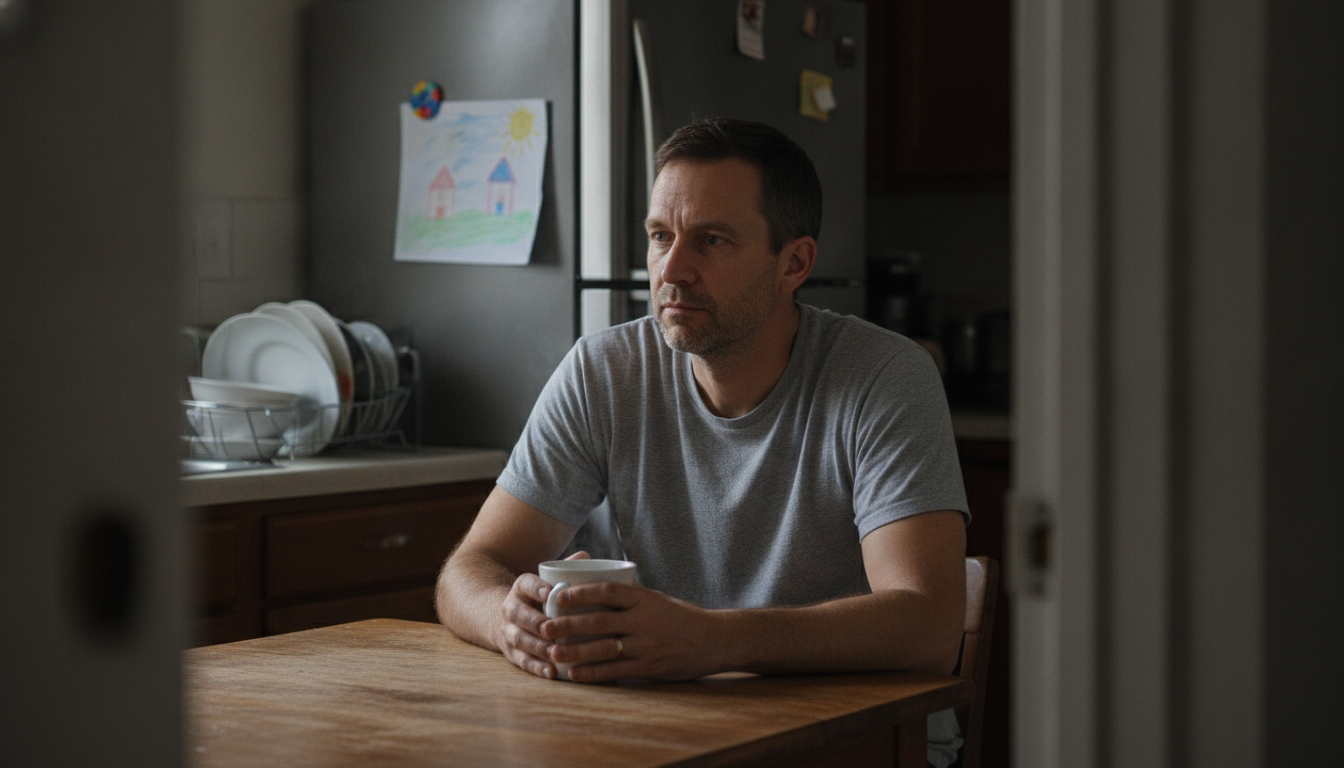
Lonely fathers are one of the least discussed public health stories of our time, and the silence around it is part of what makes it so corrosive. From the outside, the picture looks fine: a man with kids, a household, maybe a partner, a job. The social architecture of fatherhood looks like connection. What it often is, underneath, is profound isolation dressed up as a full schedule.
We are not writing this to be dramatic. We are writing it because the research is serious, the pattern is consistent, and the cultural story we tell about dads and their emotional lives is badly out of step with what is actually happening to them. So let us get into it properly.
What the Research Actually Says
The data on male loneliness has been building for years, and it paints a genuinely troubling picture. A 2021 report from the Survey Center on American Life found that the share of men with no close friends has increased fivefold since 1990, rising from 3 percent to 15 percent. That figure alone should stop people cold. One in seven men reports having no close friendships at all, and fathers are not exempt from that trend. In many ways, they are at the center of it.
The mechanism is not mysterious once you look at it clearly. Fatherhood, particularly in the early and middle years, tends to restructure a man’s entire life around logistics and responsibility. The friendships that existed before kids were often activity-based rather than emotionally grounded, which means they were fragile to begin with. When the activities disappear, so do the friends. What remains is a life that looks socially rich on paper and feels remarkably empty in practice.
Research published in the journal Social Forces has shown that parenthood, counterintuitively, is associated with reduced social integration for men compared to women, partly because mothers tend to develop new social networks through their children while fathers are less likely to do so (Nomaguchi & Milkie, 2003). The playground and the school pickup line can function as community infrastructure for mothers in ways they often do not for fathers, either because of time, culture, or both.
Beyond the social science, there is the physical health dimension. A landmark meta-analysis by Holt-Lunstad and colleagues found that social isolation and loneliness are associated with a 26 to 29 percent increase in the risk of premature mortality, effects comparable in magnitude to smoking up to 15 cigarettes a day (Holt-Lunstad et al., 2015). This is not a soft finding about feelings. This is a cardiovascular, immunological, and neurological risk factor with a body count attached to it, and lonely fathers sit squarely in its path.
Why Fatherhood Accelerates the Isolation
There is a specific texture to the loneliness that comes with being a dad, and it is worth naming carefully. It is not the loneliness of having nothing to do. It is the loneliness of being essential to everyone around you and genuinely known by almost no one. You are needed constantly and seen rarely. That particular combination is exhausting in a way that is hard to articulate without sounding ungrateful, which is precisely why most fathers never articulate it at all.
The new dad period is where the acceleration often begins. The identity shift that comes with becoming a father is seismic, and it happens largely without social support structures built to handle it. There is no real cultural container for what men go through in those early months. We have written before about the new dad identity crisis and how disorienting that rupture can be. What we want to add here is that the identity disorientation compounds the loneliness. You are not sure who you are anymore, and the people you used to be yourself with have mostly moved on or drifted.
Work complicates everything further. Many fathers pour more of themselves into professional output after having kids, either from financial pressure or because work is the one domain where the old identity, the competent and capable version of themselves, still feels legible. The workplace becomes a social substitute that does not actually deliver social nourishment. Colleagues are not the same as friends, and the distinction matters enormously when it comes to health outcomes.
There is also a grief element that almost never gets acknowledged. Lonely fathers are often grieving friendships that dissolved quietly, without any particular event or falling out. The guys you used to call, the ones you assumed would always be around, simply became people you exchange birthday reactions with on social media. Recognizing that as a loss, and allowing yourself to actually feel it as one, is something the cultural script for men actively discourages.
The Performance of Being Fine
One of the underappreciated drivers of the loneliness epidemic among fathers is the performance tax. Men, and fathers in particular, carry a culturally enforced mandate to present as capable and untroubled. This is not a new observation, but its specific effect on loneliness is worth naming. When you are performing okayness to everyone around you, you cannot be actually known. And if you cannot be actually known, you cannot be actually connected, no matter how many people are in your orbit.
This is what makes the dad loneliness epidemic so invisible from the outside. Lonely fathers are often performing sociability with tremendous skill. They show up to the barbecue, they make the group chat jokes, they do the school functions. None of it is dishonest exactly. But there is a layer of genuine interior life that is never brought into contact with another human being, and over time that gap becomes the defining feature of their social experience.
The therapeutic literature on this is clear. Emotional suppression is not a neutral strategy. Research consistently links emotional non-disclosure in men with higher rates of depression, anxiety, and somatic health problems. The performance of fine is, over time, a slow form of self-erasure, and lonely fathers are often doing it so automatically they do not notice they are doing it at all.
What Actually Helps: The Research and the Reality
Here is where we want to be careful, because there is an entire genre of wellness content that responds to the loneliness epidemic with advice that is technically correct and completely useless in practice. Join a club. Make friends. Be vulnerable. Thank you. Very helpful. What we want to do instead is be specific about what the research and legitimate lived experience point toward as genuine interventions.
Repeated Unplanned Interaction in a Consistent Context
The psychologist and friendship researcher Jeffrey Hall has studied what it actually takes to move an acquaintance into a genuine friend, and the numbers are sobering. It takes roughly 50 hours of time together to move from acquaintance to casual friend, and around 200 hours to reach the level of closeness that most people would describe as a genuine friendship. What creates those hours is not grand intentional effort. It is repeated, low-stakes, unplanned contact within a consistent shared context.
This is why the old infrastructure of neighborhoods, religious communities, and local institutions produced friendships so readily even when people did not particularly like each other. The structure did the work. For lonely fathers today, the implication is practical: finding any recurring context that puts you in the same physical space as the same people, even for mundane reasons, is more valuable than any single intentional social effort. The rec league, the regular gym class, the standing Saturday morning thing, whatever it is, the form matters less than the repetition and the physical presence.
Hobbies as Social Infrastructure
We have made this argument before in the context of why every dad needs a hobby, but it deserves reinforcement here specifically through the lens of loneliness. Hobbies are not self-indulgence for fathers. For lonely fathers specifically, they function as the social infrastructure that work and parenting no longer provide. A hobby pursued in community, whether that is a band, a running group, a woodworking class, a gaming night, creates exactly the kind of repeated contextual contact that friendship requires.
The activity itself also serves as social scaffolding. When you do not know what to talk about, you talk about the thing you are both doing. This is enormously useful for men who have been socialized to find emotional conversation awkward or threatening, because it allows genuine connection to develop through the side door of shared focus rather than requiring frontal vulnerability. The friendship happens alongside the thing, not as the explicit goal of the thing.
Therapy, Honestly
We are going to say it plainly: therapy is one of the most effective evidence-based interventions for loneliness and its mental health consequences, and fathers are dramatically underrepresented among people who access it. The reasons are familiar. Cost, stigma, the performance of fine, the sense that the problem is not bad enough to warrant professional help. None of those reasons are good enough given what the research says about where untreated chronic loneliness actually leads.
Cognitive behavioral therapy and acceptance and commitment therapy both have solid evidence bases for addressing the thought patterns and avoidance behaviors that perpetuate loneliness. The American Psychological Association has published accessible resources on the loneliness-health connection that are worth reading if you are trying to understand why this is a medical issue, not just a mood. If cost is the barrier, the SAMHSA National Helpline is a free, confidential resource for connecting to mental health services.
Lowering the Bar for What Counts as Connection
One of the more counterintuitive findings in the loneliness literature is that weak ties, the casual acquaintances, the regular barista, the neighbor you wave to, actually contribute meaningfully to a sense of social belonging. Nicholas Christakis and others studying social network health have found that the density and diversity of a person’s social contacts, not just the depth of their close relationships, predict wellbeing outcomes. For lonely fathers who feel like the bar for meaningful connection is impossibly high, this is actually useful. Not everything has to be a deep friendship to count.
This is not an argument for settling or for mistaking surface contact for real intimacy. It is an argument for not dismissing the small interactions while you are waiting for the big ones. The running total of brief genuine human contacts across a week matters more than most men think it does.
Making Dad Friends, Which Is Genuinely Hard
Loneliness research consistently shows that shared identity and shared life stage are powerful accelerants for friendship formation. This is why dad-specific social contexts are not a niche nicety but a genuine intervention point. Finding other fathers at a similar stage, with similar constraints on time and similar existential preoccupations, removes a lot of the friction that makes adult friendship so difficult. You do not have to explain why you cannot stay out past 9:30. You do not have to justify why you care about the things you care about now.
We know the making-dad-friends thing is awkward and nobody wants to admit it feels a little like dating. We have a whole piece on the unwritten rules of making dad friends if you want the tactical breakdown. The short version here is: initiate more than feels comfortable, be specific rather than vague when making plans, and accept that some attempts will go nowhere and that is not a referendum on you.
The Structural Problem Nobody Wants to Solve
We would be doing this topic a disservice if we wrapped it entirely in individual solutions, because the loneliness epidemic among fathers is not just a collection of individual failures to connect. It is also a structural problem, one that reflects how American life has been organized around productivity, mobility, and consumption in ways that systematically destroy the social fabric that communities used to provide automatically.
Lonely fathers are not lonely primarily because they are bad at friendship. They are lonely because they live in a society that has quietly dismantled most of the third places, the churches, the union halls, the neighborhood bars, the community organizations, where incidental, repeated, cross-generational human contact used to happen without anyone having to organize it intentionally. The surgeon general of the United States declared loneliness a public health crisis, and that designation was not an accident. It was a recognition that the scale of the problem exceeds what individual behavior change can address on its own.
That is not a reason for fatalism. It is a reason for honesty. When we tell lonely fathers that the solution is just to be more intentional about connection, without acknowledging that the environment they are trying to connect in is structurally hostile to it, we are being a little dishonest about the degree of difficulty. The individual interventions above are real and worth pursuing. They are also harder than they should be, and acknowledging that is not an excuse, it is just an accurate description of the terrain.
What We Want to Say Directly
If you are a lonely father reading this, we are not going to tell you that reaching out is easy or that vulnerability will feel natural right away or that everything gets better if you just follow the steps. That is not what the research says, and it is not what honest experience says either. What the research does say is that the isolation you are feeling is not unique to you, it is not a personal failing, and it has consequences serious enough that it deserves your attention at the same level of seriousness you would give a persistent physical symptom.
Lonely fathers are not a niche or a demographic quirk. They are a large, largely silent population carrying a health burden that gets misread as fine because it does not look like crisis from the outside. The kids are okay. The mortgage gets paid. The lawn gets mowed. And underneath that, a man is slowly becoming less known to anyone, including himself.
That is worth taking seriously. We take it seriously here. And if this piece is the thing that makes one dad decide to text the guy he has been meaning to text, or look up a therapist, or finally show up to the thing he has been putting off, then we will take that as a win in the only metrics column that actually matters to us.
References
Holt-Lunstad, J., Smith, T. B., Baker, M., Harris, T., & Stephenson, D. (2015). Loneliness and social isolation as risk factors for mortality: A meta-analytic review. Perspectives on Psychological Science, 10(2), 227–237. https://doi.org/10.1177/1745691614568352
Nomaguchi, K. M., & Milkie, M. A. (2003). Costs and rewards of children: The effects of becoming a parent on adults’ lives. Journal of Marriage and Family, 65(2), 356–374. https://doi.org/10.1111/j.1741-3737.2003.00356.x
Cox, D. A. (2021). The state of American friendship: Change, challenges, and loss. Survey Center on American Life. https://www.americansurveycenter.org/research/the-state-of-american-friendship-change-challenges-and-loss/