Grief, Loss, and Fatherhood: Processing Pain While Holding It Together
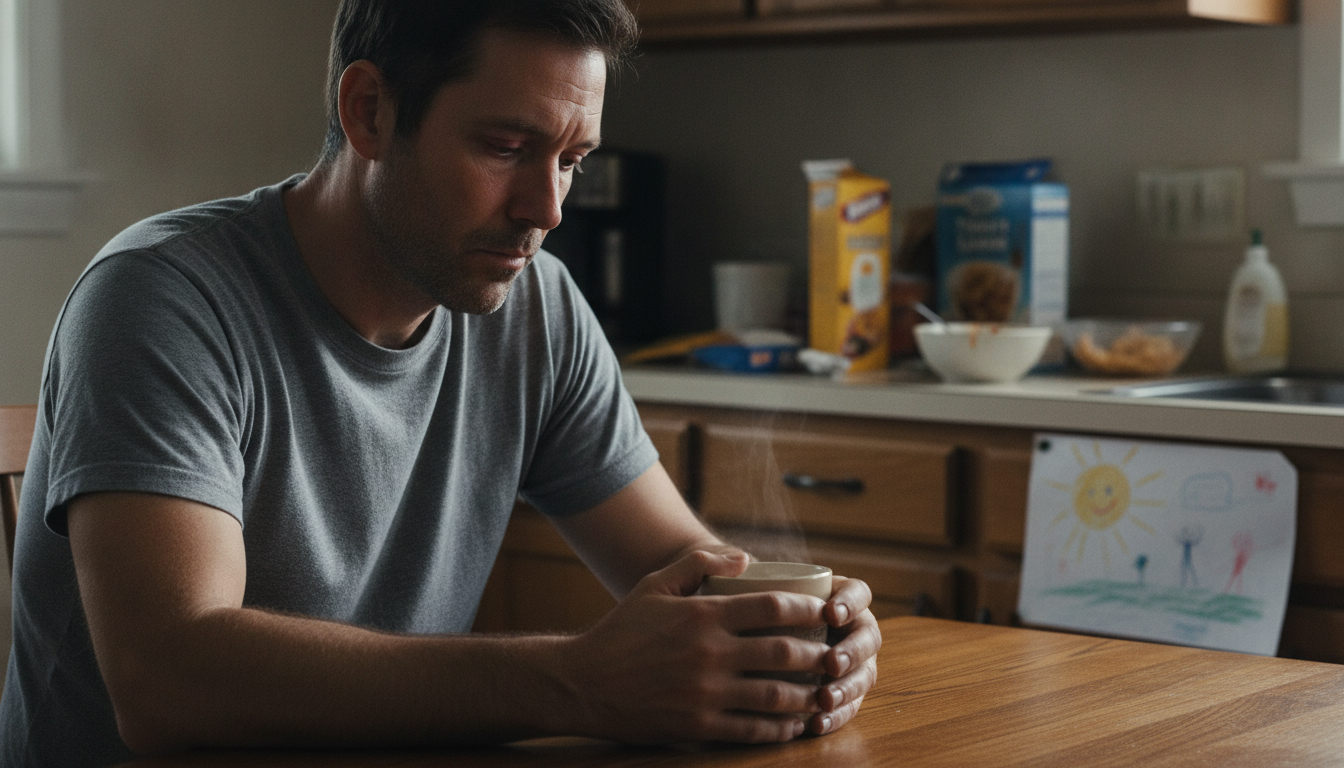
Nobody hands you a manual for grief and fatherhood arriving at the same time. One moment you are the person your kids run to when something breaks, and the next you are standing in the cereal aisle trying to remember what you came in for because your brain has been quietly dismantled by loss. Whether you are dealing with the death of a parent, a sibling, a close friend, a pregnancy, or any kind of significant loss, the experience of grieving while actively parenting is one of the most disorienting things a dad can go through.
We want to talk about it honestly. Not with platitudes, not with a five-step program, but with some real information about what grief actually does to you, why dads tend to process it in ways that create problems down the road, and what the research suggests actually helps.
What Grief Actually Does to the Brain and Body
Grief is not a feeling. It is a full physiological event. The brain regions that process social bonding and physical pain overlap significantly, which is why losing someone important does not just hurt emotionally. It genuinely hurts. Neuroimaging research reviewed by Eisenberger (2012) shows that the dorsal anterior cingulate cortex and the anterior insula, regions tied to the distress of physical pain, also become more active during social pain, including when bereaved people look at pictures of a loved one who has died. When you hear someone say grief feels like a punch to the chest, they are describing something real, not poetic.
Beyond the brain, grief tends to show up in the body as well, in disrupted sleep, scattered concentration, and a general physical heaviness. You are not being weak when you cannot concentrate or feel physically run down in the weeks after a significant loss. Your body is responding to a threat it was designed to take seriously.
The Specific Problem of Being the Dad Who Holds It Together
Here is where grief and fatherhood create a particular trap. Dads are often cast, and often cast themselves, in the role of stabilizer. You manage the logistics of death. You handle the calls, the arrangements, the paperwork. You stay functional for your partner and your kids while everyone else around you is allowed to fall apart. It looks like strength from the outside. From the inside, it is often just deferred processing.
Grief researchers Terry Martin and Kenneth Doka describe a pattern they call “instrumental grieving,” which focuses on tasks and problem-solving rather than emotional expression, and they note that it is more common in men, although it is not determined by gender (Martin & Doka, 2000). This is not pathological on its own. It becomes a problem when it is the only gear available, and when the emotion never gets processed at all. The engine keeps running but the warning light stays on.
There is also a social permission gap. If your partner is grieving visibly, they will likely receive more direct emotional support from family and friends. Dads often receive a hand on the shoulder and a “you’re doing great.” That gap in support is not harmless. It means you are processing with fewer resources and less external scaffolding, which makes the whole thing harder and longer.
What Your Kids Actually Need From You When You Are Grieving
This is where a lot of dads get stuck in a painful misunderstanding. There is a belief, completely understandable and entirely wrong, that protecting your kids means hiding your grief from them entirely. We think the opposite is closer to the truth, because seeing the adults around them grieve in measured, age-appropriate ways can teach children that loss is survivable, that emotions are not emergencies, and that the adults in their lives are real people rather than performance installations.
The research on bereaved kids points in the same direction. A study of 313 children aged 8 to 16 who had recently lost a parent found that positive parenting from the surviving caregiver was associated with fewer mental health problems in those children (Haine et al., 2006), and the same research group argues that how children adapt after a death depends heavily on the environment around them, including the adults who are still there (Sandler et al., 2008). Your kids do not need you to be a robot. They need you to be honest and present at the same time, which is genuinely hard, and which is also what you are already trying to do.
What this looks like in practice is saying something simple and true. “I am really sad today because I miss grandpa” is more useful to a seven-year-old than a dad who seems fine but is visibly not fine in ways the kid cannot name or understand. Children are extraordinarily perceptive about emotional incongruence. They feel the distance even when they cannot articulate it, and that unnamed distance is often more frightening than the grief itself.
Keeping Routines Intact as Much as Possible
Structure is not a distraction from grief. For kids, it is one of the primary signals that the world is still safe. School, bedtime, dinner at the table, the same Saturday morning ritual with cartoons and cereal. These things do not minimize what happened. They provide a floor, and a grieving dad holding that floor in place is doing genuinely important work even when it does not feel like much.
You are also, in maintaining those routines, giving yourself something concrete to anchor to. That is not avoidance. That is one of the legitimate functions of task-oriented coping, and it can coexist with deeper emotional processing if you build space for both.
The Compounded Grief That Comes With Fatherhood Itself
Sometimes grief and fatherhood are not just happening at the same time. Sometimes fatherhood is the source of grief. Miscarriage, stillbirth, infertility, the loss of a child at any age. These are forms of loss that carry an additional layer of social invisibility, particularly for dads. There is a cultural assumption that the mother bears the primary weight of pregnancy loss, and while her experience is undeniably central, it does not follow that the father is not also grieving a person, a future, a version of his life.
A dad who has lost a pregnancy or a child can easily feel like he needs to prioritize his partner’s grief over his own. This is not a character flaw. It comes from love. But it can result in a grief that never gets named, never gets space, and eventually surfaces as something harder to recognize, like numbness, disconnection, or a low-grade anger that has nowhere to go. If this resonates, that grief is real, it counts, and it deserves actual support. We wrote about the identity rupture that comes with becoming a dad, and loss compounds that rupture in ways that deserve their own attention.
What Actually Helps: Evidence-Based Approaches to Grief
We are not going to tell you to journal more or take a bath. Here is what actually helps, and where the research stands on it.
Meaning-Making Over Time
One of the more useful ideas in grief research comes from Robert Neimeyer’s work on meaning reconstruction. The idea is that significant loss shatters the assumptive world, the implicit framework through which we understand our lives and our place in them. Recovery is less about “moving on” and more about rebuilding a coherent narrative that incorporates the loss without being consumed by it. In a study of 506 young adults who had lost someone within the previous two years, being able to make sense of the loss tended to soften the effect of risk factors that otherwise predicted heavier grief, and finding some benefit in the experience was linked to fewer symptoms of complicated grief (Neimeyer et al., 2006). This is not a quick process, and it is not linear, but for many people it does happen with time and adequate support.
For dads specifically, meaning-making often happens through doing. Building something in a person’s memory, continuing a tradition they valued, raising kids who carry something of who they were. These are not just sentimental gestures, because staying connected to the person who died can be a healthy part of grieving. The same study adds an important caveat, though: a strong ongoing bond was linked to more distress when people had not been able to make sense of the loss, which is one more reason the meaning-making work matters (Neimeyer et al., 2006).
Social Connection, Even When It Feels Impossible
Grief is isolating by nature, and dads are already navigating a social landscape where emotional vulnerability is often unwelcome. We have written before about the difficulty of making genuine connections as a dad, and grief makes that harder. Having people around you does not make grief go away, but carrying it completely alone makes it heavier and harder to talk about.
You do not need a grief support group, though they work for some people. You need one or two people who can hold space without immediately trying to fix it or redirect you toward optimism. That is a specific kind of contact, and it is worth identifying who in your life can actually do that before you need them to.
Physical Activity as a Processing Tool
This one might be the most accessible entry point for a lot of dads. Exercise is not a grief treatment, but it is one of the simplest ways to manage the stress that comes with grief, and it aligns naturally with the way many men already regulate emotion. A run, a lift, or an hour in the garage is not a substitute for emotional processing, but it can be a legitimate part of the overall system. Bessel van der Kolk argues in his book on trauma, The Body Keeps the Score, that stress lives in the body as well as the mind, and movement is one of the ways to pay down some of that debt.
Therapy for Dads Who Would Never Call It That
If what you just thought was “I’m not a therapy guy,” that is worth examining. Research on men’s health has found a consistent pattern of men delaying help when they become ill, with traditional ideas about masculinity often given as the explanation (Galdas et al., 2005), and there is little reason to think grief is any different. You do not have to lie on a couch and discuss your childhood. Grief-focused therapy also has real trial evidence behind it. In a randomized controlled trial of 95 adults with complicated grief, a 16-session treatment designed specifically for grief produced a response rate of 51%, compared with 28% for standard interpersonal psychotherapy (Shear et al., 2005). If the word therapy is the sticking point, look for a grief counselor or a bereavement specialist. Same function, different label.
Online therapy has also significantly lowered the barrier to access, and for dads with packed schedules and limited privacy, that matters. Research on internet-delivered therapy has found that guided programs for anxiety and depression tend to produce results similar to face-to-face treatment (Andersson et al., 2019), so a screen is a legitimate place to start.
When Grief Becomes Something More
The DSM-5-TR now includes Prolonged Grief Disorder as a diagnosable condition, defined broadly as intense grief that remains debilitating beyond twelve months after a loss, with specific criteria around yearning, identity disruption, and functional impairment. A meta-analysis of 14 studies estimated that it affects roughly one in ten adults bereaved by non-violent deaths (Lundorff et al., 2017), and it is meaningfully distinct from major depression, though the two can co-occur. Knowing this condition exists matters because it means that if you are still functionally flattened a year out, something treatable is happening. This is not a character failing or a sign that you loved someone too much. It is a clinical presentation with effective treatments.
Watch for signs that grief is crossing into territory that requires professional attention: inability to function at work over an extended period, withdrawal from your kids, substance use as a primary coping tool, persistent thoughts of death or suicidal ideation, or a complete inability to imagine any kind of future. These are signals to take seriously and act on, not push through.
You Are Allowed to Grieve and Still Be a Good Dad
These two things are not in opposition. You can be in genuine pain and still show up. You can have days where you are clearly not okay and still be exactly the father your kids need. The standard we are all holding ourselves to, the dad who processes everything cleanly and is fully present at every moment, does not exist and never did. Real fatherhood involves being a human being in front of your children, and human beings lose people they love.
The goal is not to perform normalcy until you feel it. The goal is to stay connected to your kids, get actual support for yourself, and trust that grief, given room and time and some measure of honesty, does change shape. It does not disappear, and you probably would not want it to. But it does become something you carry differently. That is not nothing. That is actually the whole ballgame.
References
Andersson, G., Titov, N., Dear, B. F., Rozental, A., & Carlbring, P. (2019). Internet-delivered psychological treatments: From innovation to implementation. World Psychiatry, 18(1), 20-28. https://doi.org/10.1002/wps.20610
Eisenberger, N. I. (2012). The pain of social disconnection: Examining the shared neural underpinnings of physical and social pain. Nature Reviews Neuroscience, 13(6), 421-434. https://doi.org/10.1038/nrn3231
Galdas, P. M., Cheater, F., & Marshall, P. (2005). Men and health help-seeking behaviour: Literature review. Journal of Advanced Nursing, 49(6), 616-623. https://doi.org/10.1111/j.1365-2648.2004.03331.x
Haine, R. A., Wolchik, S. A., Sandler, I. N., Millsap, R. E., & Ayers, T. S. (2006). Positive parenting as a protective resource for parentally bereaved children. Death Studies, 30(1), 1-28. https://doi.org/10.1080/07481180500348639
Lundorff, M., Holmgren, H., Zachariae, R., Farver-Vestergaard, I., & O’Connor, M. (2017). Prevalence of prolonged grief disorder in adult bereavement: A systematic review and meta-analysis. Journal of Affective Disorders, 212, 138-149. https://doi.org/10.1016/j.jad.2017.01.030
Martin, T. L., & Doka, K. J. (2000). Men don’t cry, women do: Transcending gender stereotypes of grief. Brunner/Mazel.
Neimeyer, R. A., Baldwin, S. A., & Gillies, J. (2006). Continuing bonds and reconstructing meaning: Mitigating complications in bereavement. Death Studies, 30(8), 715-738. https://doi.org/10.1080/07481180600848322
Sandler, I. N., Wolchik, S. A., & Ayers, T. S. (2008). Resilience rather than recovery: A contextual framework on adaptation following bereavement. Death Studies, 32(1), 59-73. https://doi.org/10.1080/07481180701741343
Shear, K., Frank, E., Houck, P. R., & Reynolds, C. F., III. (2005). Treatment of complicated grief: A randomized controlled trial. JAMA, 293(21), 2601-2608. https://doi.org/10.1001/jama.293.21.2601