Screen Time and Your Brain: What the Studies Say About Doom Scrolling
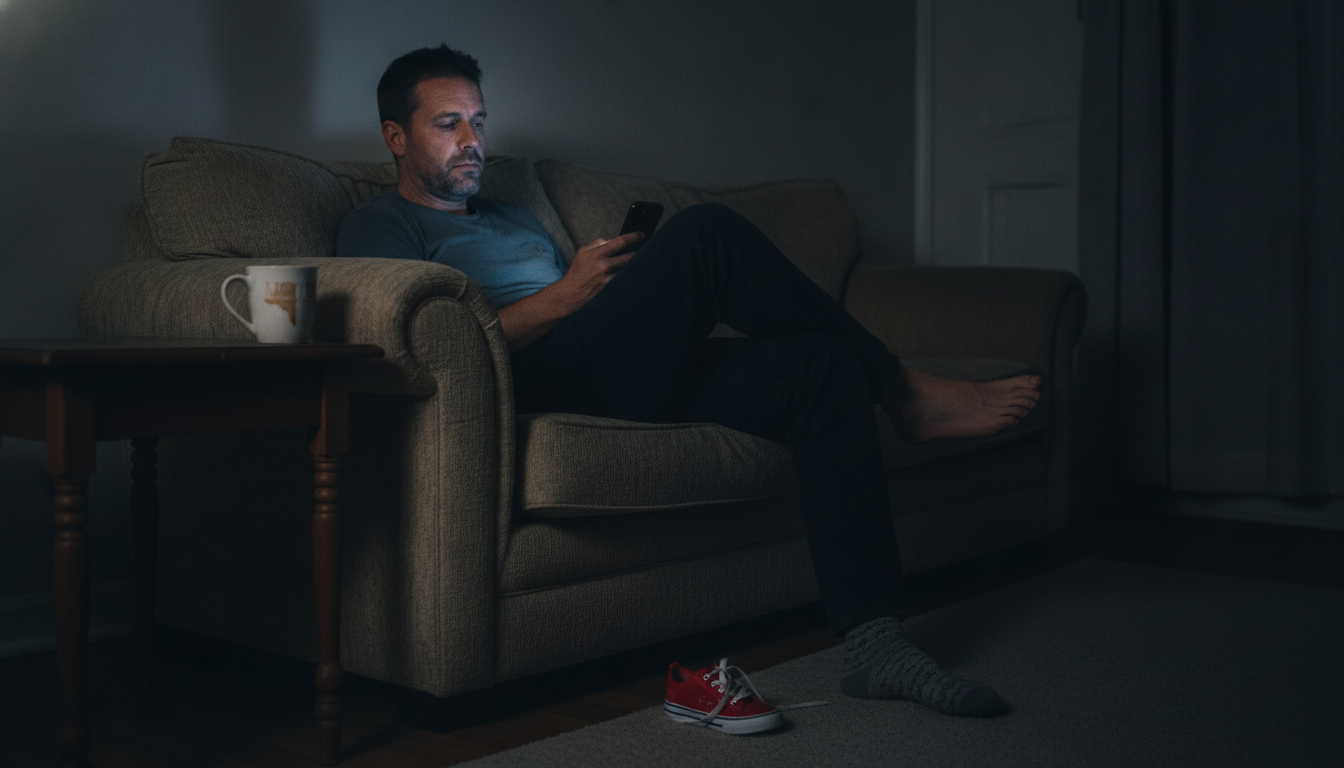
Doom scrolling effects on mental health have become one of the more quietly urgent conversations in behavioral research, and if you are a dad burning through your phone at midnight while the house sleeps, that conversation is about you. We are not here to lecture you about screen time like you are a twelve-year-old whose iPad got confiscated. We are here to show you what the data actually says, because it is more interesting and more actionable than any generic “put down the phone” hot take you have already ignored.
The doom scrolling effects on mental health literature has expanded significantly over the last several years, moving from anecdotal concern to a body of peer-reviewed work with some real teeth. Understanding the mechanisms involved is worth the fifteen minutes it takes to read this, because once you see what is happening at the neurological and psychological level, the behavior starts to make a different kind of sense.
What Doom Scrolling Actually Is (Beyond the Buzzword)
Doom scrolling refers to the compulsive consumption of negative news and distressing content through social media feeds, news apps, and short-form video platforms, typically continuing even after the user is aware the content is making them feel worse. The term entered mainstream use around 2020 and has since been operationalized in psychological research as a measurable behavior pattern. It is distinct from casual browsing or passive entertainment in that it is specifically characterized by a negative valence loop: the content is distressing, the distress increases engagement, and engagement reinforces more consumption.
For dads specifically, the behavior tends to cluster at predictable times. Late evening after the kids are down is the most common window, which is also when cognitive defenses are lowest and the pull of low-effort stimulation is highest. You are exhausted, you have earned thirty minutes of nothing, and thirty minutes of nothing somehow turns into ninety minutes of war footage, economic anxiety content, and comment sections that should carry a biohazard warning.
The Neuroscience of the Negative Spiral
Your brain has a well-documented negativity bias, meaning it allocates more cognitive resources to threatening or negative information than to neutral or positive information. This is evolutionary hardware, not a character flaw. The same mechanism that kept your ancestors scanning the treeline for predators is now being exploited by engagement-optimized algorithms that have learned, through billions of data points, that threat and outrage are the most reliable traffic drivers.
A study of 563 emerging adults published in the Journal of Affective Disorders found that more time spent on social media each day was associated with greater anxiety symptoms and higher odds of a probable anxiety disorder (Vannucci et al., 2017). Because that study captured a single moment in time, it cannot tell us which way the arrow points: anxious people may seek out more content, more content may feed more anxiety, or the two may reinforce each other. Either way, the scroll is a poor substitute for the relief it seems to promise.
The dopamine system is also in the mix here, though perhaps not in the way you have heard it described. The reward is not in the bad news itself. The reward is in the anticipation of the next piece of information, the micro-hit of novelty that comes with each new post. B.F. Skinner’s variable ratio reinforcement schedule, the same mechanism behind slot machines, maps almost perfectly onto the infinite scroll format. You keep pulling because the next one might be the one that finally makes sense of everything, and it never is.
What the Studies Specifically Say About Doom Scrolling Effects on Mental Health
A nationally representative study of 6,514 U.S. adults published in Science Advances found that, in the early weeks of the pandemic, people who spent more hours each day consuming COVID-19 media reported higher acute stress and more depressive symptoms (Holman et al., 2020). Crucially, that association held even after the researchers accounted for direct personal exposure, such as a diagnosis in yourself or someone close to you, along with pandemic-related job and wage losses. You did not need to know anyone who got sick. The feed was sufficient.
The doom scrolling effects on mental health extend beyond mood into sleep architecture, which is where dads tend to feel the compounding damage most acutely. Blue light suppression of melatonin is the part everyone has heard about, but the content itself is arguably the bigger problem. Consuming threat-coded information activates the hypothalamic-pituitary-adrenal axis and triggers cortisol release at exactly the moment your body needs to be winding down. You are biologically preparing for a threat that exists only on a screen, and your nervous system does not know the difference.
A study published in PLoS ONE that directly measured smartphone screen time in 653 adults found that more screen time, particularly around bedtime, was associated with shorter sleep, poorer sleep quality, lower sleep efficiency, and taking longer to fall asleep (Christensen et al., 2016). For a dad who is already sleep-deprived from the standard operational demands of parenthood, that compounding effect is not trivial. It is the difference between being a functional, present father the next day and running on fumes through your kid’s soccer game while your phone is back in your pocket and the urge to check it is already building.
The Autonomy Paradox
Here is something the research surfaces that does not get enough attention. People who doom scroll are often doing it in part as an expression of autonomous downtime, the sense that after a day of performing for a job, a partner, and children, this is finally the time that belongs to them. The phone becomes a symbol of personal space even as the content on it is actively degrading the quality of that space. We have written before about why every dad needs a hobby, and the scroll often fills the slot that a genuine hobby would occupy, delivering stimulation without restoration.
This distinction between stimulation and restoration is not semantic. Restorative activities reduce physiological arousal and allow the prefrontal cortex to recover from a day of executive function demands. Doom scrolling produces stimulation that masquerades as rest because your body is horizontal and your eyes are closed to the rest of the room. Your nervous system, however, is doing anything but resting.
Dads, Identity, and the Anxiety Feed
There is a specific flavor of doom scrolling that targets fathers, and it tends to aggregate around economic uncertainty content, geopolitical instability, environmental threat narratives, and the general sense that the world your kids are inheriting is on fire. This is not irrational. The concerns are real. But the feed is not giving you information that helps you respond to those concerns. It is giving you an endless stream of threat signals with no corresponding action pathway, and that combination is a reliable recipe for learned helplessness.
The transition into fatherhood already involves a significant identity recalibration, something we explored in depth in our piece on the new dad identity crisis. When a man who is already working through questions about purpose, control, and adequacy spends his free hours consuming content designed to amplify threat perception, the psychological toll compounds in ways that are difficult to separate from ordinary stress. It looks like being tired. It feels like being worried. It is actually a behavior loop with a structural solution.
Screen Time and the Adult Brain: A Clearer Picture
The screen time conversation in mainstream media tends to focus on children and adolescents, which is where the most dramatic developmental effects are documented. But the research on screen time in adults is also substantive and worth taking seriously. The doom scrolling effects on mental health in grown men do not look like attention disorders or developmental delays. They look like chronic low-grade anxiety, emotional dysregulation, difficulty being present, and a shortening of the attention window that makes sustained engagement with anything, including your own kids, harder than it used to be.
A study published in Preventive Medicine Reports analyzed national health survey data from 3,201 U.S. adults and found that people who spent more than six hours a day watching TV or using a computer outside of work or school had more than twice the odds of moderate to severe depression compared with people who logged under four hours, after accounting for factors such as gender, education, and poverty (Madhav et al., 2017). Because the data capture a single moment in time, the authors are clear that the study cannot show whether screens feed depression or depression pulls people toward screens. That uncertainty is worth sitting with if you have told yourself you will stop when things feel less overwhelming, because heavy screen time and low mood clearly travel together, and waiting for one to fix itself before touching the other may not be the winning strategy.
The Comparison Layer
On top of the anxiety generated by negative news content, social media adds a comparison mechanism that operates largely below conscious awareness. You are not just reading about external threats. You are also, on the same platform in the same session, receiving social comparison information that benchmarks your finances, your body, your parenting, and your career against a curated highlight reel assembled by an algorithm that knows exactly which images will keep your eyes on the screen longest. The doom scrolling effects on mental health are therefore not just about news. They are about the whole ecosystem of the feed.
This is worth naming because it changes the intervention logic. Switching from news to Instagram does not solve the problem. It just routes the same underlying mechanism through a different content category. The architecture of compulsive, passive, variable-reward scrolling is the issue, not the specific type of content.
What Actually Works: Structural Changes Over Willpower
Willpower-based approaches to reducing screen time have a poor track record, and the behavioral research makes clear why. When you are fatigued, your capacity for effortful self-regulation is already depleted, which is precisely when the urge to scroll is strongest. Relying on willpower to resist an algorithmically optimized system at 11pm after a full day of parenting and work is like showing up to a chess match after pulling an all-nighter and expecting to win because you are a decent player.
Structural interventions are what the evidence supports. Charging your phone outside the bedroom removes the device from the environment where the most damaging late-night scrolling occurs. App-level time limits with a delay-to-override feature create a friction point that interrupts the automatic quality of the behavior. Scheduling a specific news window, one block of time with a defined endpoint, gives you genuine information access without the open-ended consumption loop. None of these require extraordinary discipline. They require one deliberate decision made in advance, during a moment when you have the cognitive bandwidth to make it.
The American Psychological Association’s guidance on social media and mental health echoes this structural framing, emphasizing intentional use and environment design over reliance on in-the-moment resistance. The Sleep Foundation’s recommendations on technology in the bedroom further support the environment design approach, noting that the mere presence of a phone in the sleep environment affects sleep quality even when the phone is not actively being used.
What Replacement Actually Looks Like
The research on habit replacement consistently shows that removal without substitution has a lower success rate than removal with a competing behavior. You need something to do with the slot that doom scrolling was filling. This does not have to be impressive. It does not have to be a meditation practice or a gratitude journal. It can be a paperback book, a podcast with a defined episode length, ten minutes of stretching, or just sitting with your thoughts for longer than feels comfortable. The goal is to give your nervous system an off-ramp that does not route back onto the anxiety highway.
We are not telling you to become a different person. We are pointing at a behavior loop that the research identifies as genuinely harmful to adult mental health, and offering you the structural logic that gives you a real chance of changing it. The doom scrolling effects on mental health are not abstract. They show up the next morning in your patience level, your ability to be present, and the quality of the attention you can offer the people who need it from you most.
The Bottom Line
Doom scrolling effects on mental health are documented, they grow with the hours you spend in the feed, and they operate through mechanisms that are well understood by behavioral science. The negativity bias, variable reinforcement, HPA axis activation, sleep disruption, and social comparison processes are not opinions about phones. They are descriptions of what is actually happening in your brain and body while you scroll. Knowing the mechanism does not automatically change the behavior, but it does change the framework for addressing it, from a discipline problem to a design problem, and design problems have solutions.
You do not have to detox from the internet or go off the grid or install parental controls on your own phone. You have to make a few structural changes during daylight hours when your prefrontal cortex is online and available for consultation. The research backs this approach. Your kids need the version of you that it produces.
References
Christensen, M. A., Bettencourt, L., Kaye, L., Moturu, S. T., Nguyen, K. T., Olgin, J. E., Pletcher, M. J., & Marcus, G. M. (2016). Direct measurements of smartphone screen-time: Relationships with demographics and sleep. PLoS ONE, 11(11), Article e0165331. https://doi.org/10.1371/journal.pone.0165331
Holman, E. A., Thompson, R. R., Garfin, D. R., & Silver, R. C. (2020). The unfolding COVID-19 pandemic: A probability-based, nationally representative study of mental health in the United States. Science Advances, 6(42), Article eabd5390. https://doi.org/10.1126/sciadv.abd5390
Madhav, K. C., Sherchand, S. P., & Sherchan, S. (2017). Association between screen time and depression among US adults. Preventive Medicine Reports, 8, 67-71. https://doi.org/10.1016/j.pmedr.2017.08.005
Vannucci, A., Flannery, K. M., & Ohannessian, C. M. (2017). Social media use and anxiety in emerging adults. Journal of Affective Disorders, 207, 163-166. https://doi.org/10.1016/j.jad.2016.08.040