The Psychology of Why Music Hits Different When You’re a Parent
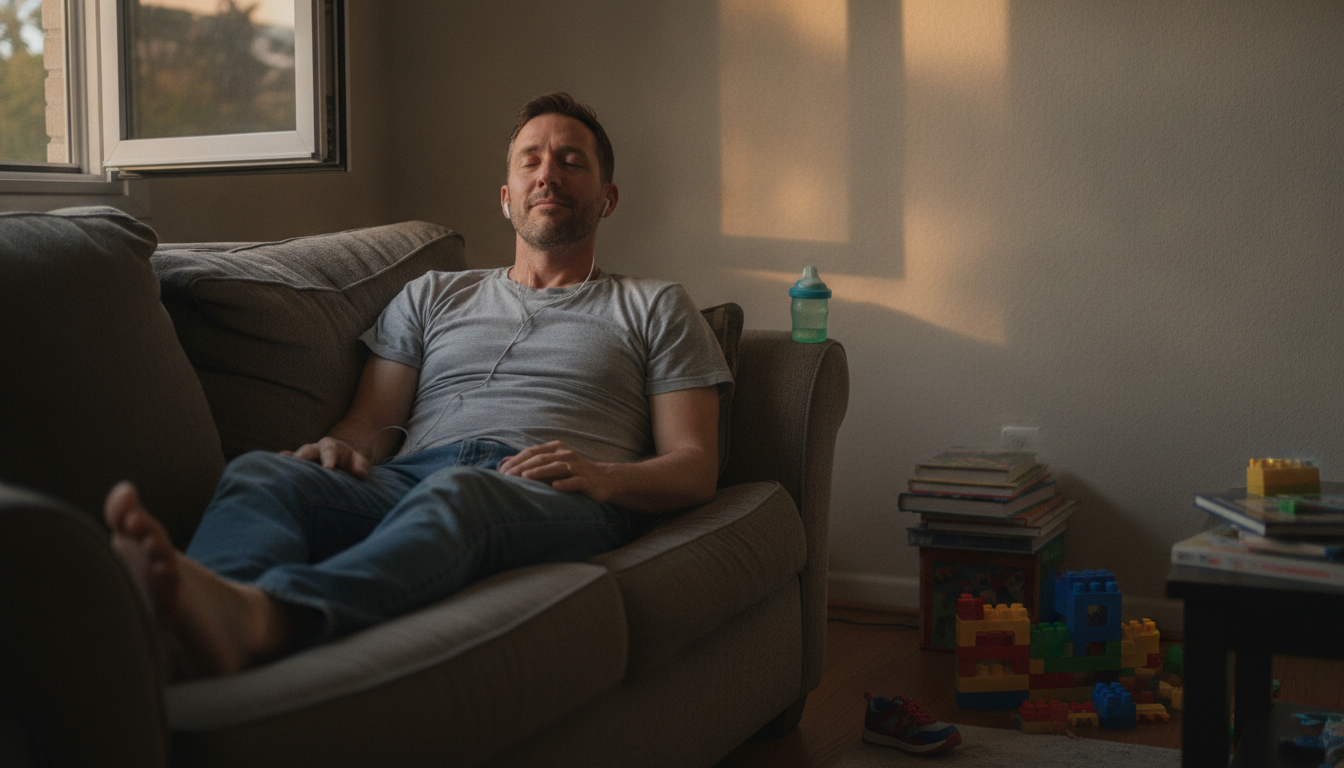
If you have ever been blindsided by a song you have heard a hundred times before, only now it makes you grip the steering wheel a little tighter because your kid is in the backseat, you are not losing it. The music emotional response parents experience is genuinely different from what you felt before you had children, and the neuroscience and psychology behind it are worth understanding. This is not a soft feelings piece. This is about what is actually happening in your brain, and why fatherhood rewires the way sound lands.
We have talked in the band about this more times than we can count. A song that used to be background noise becomes a gut punch. An old record you loved at 22 now carries so much more weight that you have to turn it off in the car. That shift is not random sentimentality. There are real mechanisms at work, and once you understand them, the whole experience starts to make a different kind of sense.
Your Brain on Music Was Already Vulnerable
Before we get to fatherhood specifically, it helps to understand what music is doing to the brain in the first place. Music activates the mesolimbic dopamine system, the same reward circuitry involved in food, sex, and connection. A landmark study published in Nature Neuroscience found that listening to music you love produces dopamine release both in anticipation of a peak moment in a song and at the moment itself, a dopamine double-hit that almost nothing else in ordinary life replicates (Salimpoor et al., 2011). You were already neurologically primed to feel music deeply. Parenthood just changed the emotional variables feeding into that system.
The auditory cortex does not process music in isolation. It is constantly pulling context from the limbic system, where emotional memory lives, and from the prefrontal cortex, where meaning-making happens. Every song you hear is being cross-referenced with your entire emotional history simultaneously. When that history now includes a child who depends on you completely, the cross-referencing gets a lot louder.
What Fatherhood Actually Does to Your Emotional Architecture
Becoming a parent is one of the few experiences in adult life that produces measurable structural changes in the brain. Fathers are no exception, and researchers have now tracked those changes in first-time dads across the transition to parenthood. One study that scanned men before their partners became pregnant and again in the months after the birth found reductions in cortical volume and thickness in a region called the precuneus, and the fathers who showed more of that change also showed stronger brain responses to pictures of their own baby (Paternina-Die et al., 2020). A follow-up study drawing on two international samples, one in Spain and one in California, found cortical volume reductions in the default mode and visual networks of first-time fathers (Martínez-García et al., 2023). This is not metaphor. The brain you are using to listen to music after having kids is, in a meaningful neurological sense, a different brain than the one you had before.
What this means practically is that your capacity to feel is wider. The emotional range that fatherhood forces open, from terrifying vulnerability to a kind of love that has no ceiling, becomes the new baseline your nervous system is operating from. Music, which has always worked by moving emotional states, now has a much larger instrument to play. The keys go lower and higher than they used to.
The Role of Oxytocin in All of This
Oxytocin, the neurochemical most associated with bonding and attachment, is part of the story for dads as well as moms. A study of first-time parents found that fathers’ oxytocin levels were no different from mothers’ in the first six months after birth, and that fathers with higher oxytocin engaged in more stimulating contact with their babies, such as encouraging exploration and directing the baby’s attention to objects (Gordon et al., 2010). Music appears to touch the same system. In a small randomized trial, heart surgery patients who listened to soothing music during bed rest showed a rise in oxytocin, while patients who rested without music showed a drop (Nilsson, 2009). Nobody has yet tested whether caregiving and music combine to produce a bigger oxytocin response in fathers, so treat that link as an educated guess rather than a finding. It is still a plausible piece of why a song can hit with a force that feels almost disproportionate to the song itself, when in fact the response is probably just accurate to where you actually are.
Nostalgia Music Psychology and Why the Old Stuff Wrecks You Now
Nostalgia music psychology is a field that has grown considerably in the last decade, and its findings are directly relevant to what parents experience. Nostalgia, as researchers now understand it, is not simple wistfulness. It is a complex emotional state that involves longing, warmth, and a sense of bittersweet meaning, and it has measurable psychological benefits including increased feelings of social connectedness and continuity of self (Sedikides et al., 2008). The music you loved during emotionally formative periods, typically adolescence and early adulthood, is permanently encoded with some of the strongest memory and identity associations your brain will ever form.
When you become a parent, your sense of identity undergoes a seismic reorganization. If you want a deeper look at how that identity shift actually plays out in the early days, our piece on the new dad identity crisis covers the terrain honestly. But what matters here is that nostalgia music is doing double duty after you have kids. It is connecting you to who you were before fatherhood and simultaneously reminding you how far that self now feels from where you stand today. That tension is emotionally loaded in a way it simply was not before.
The Reminiscence Bump and What It Means for Dads in Their 40s
Cognitive psychologists have documented what is called the reminiscence bump, the well-established phenomenon where people recall a disproportionate number of vivid memories from roughly ages 10 to 25. Music from that window is stored with exceptional emotional fidelity because it was laid down during a period of intense identity formation, hormonal peak, and novel experience. If you are a dad in your late 30s or 40s, the music from your adolescence is not just old songs you liked. It is the soundtrack of who you were becoming.
Hearing that music now, through the filter of fatherhood, creates a kind of temporal vertigo. You are simultaneously the kid who first heard this song and the adult watching your own child grow up in what feels like real time. That double exposure is exactly why a track from 25 years ago can hit harder today than it did when it was new.
Why Lyrics Land Differently Now
Songs about leaving, about time passing, about love that cannot last, about growing up, all of them recalibrate when you are raising a child. The music emotional response parents describe most often involves lyrics they had heard dozens of times without real impact suddenly becoming unbearable in the best and worst way. Cats in the Cradle is the obvious example that everyone cites, but it happens with songs that are not even about children. A song about a long road trip, a song about a friendship that faded, a song about a house you grew up in. These things land differently because your relationship with time has changed fundamentally.
Before kids, time is something you mostly move through without much friction. After kids, you become acutely aware that it is moving whether you are paying attention or not. Every age your child passes through is an age they will never be again. That awareness does not turn off when you put your earbuds in. It comes with you, and it colors everything you hear.
Music as Emotional Regulation for Fathers
There is a practical dimension to all of this that does not get enough attention. Fathers, particularly those still navigating the emotional recalibration of early parenthood, often have fewer socially sanctioned outlets for emotional processing than mothers do. Music has historically served as one of the few spaces where men can feel without it requiring any kind of verbal explanation or social negotiation. You do not have to explain to anyone why a song is affecting you. You can just let it.
Research on music and emotional regulation consistently finds that people use music intentionally to shift mood states, process difficult feelings, and access emotions they struggle to reach through other means. For dads who are quietly carrying a lot, a long drive with the right record on is not trivial. It is one of the more efficient emotional maintenance tools available, and it does not require a co-pay. We have written about why maintaining your own inner life as a father matters over at our piece on why every dad needs a hobby, and music absolutely qualifies.
Sharing Music With Your Kids Changes Your Relationship to It Again
There is another layer to the music emotional response parents experience that kicks in once your kids are old enough to actually engage with what you are playing. The moment a song you love becomes a song your child loves, it gets encoded with an entirely new layer of meaning. Now it belongs to two timelines simultaneously. It is yours from before, and it is theirs from now, and it is yours together from this specific window of their childhood that you will never get back.
Some of the most disarming moments in fatherhood come from watching a kid have their first real reaction to a piece of music. They do not have the filters yet. They just feel it. And watching that unguarded response from a small person who came from you has a way of cracking something open that you did not know was sealed. You are not just hearing the song anymore. You are watching someone you love hear it for the first time, and that experience is not reproducible.
What to Do With All of This
Nothing, necessarily. Understanding why music hits differently when you are a parent is not a problem that requires a solution. But it is worth sitting with the awareness that what you are experiencing is neurologically real, developmentally appropriate, and honestly a pretty reliable signal that you are paying attention to your life in a way that matters. The fathers who feel music deeply are, generally speaking, the ones who are present enough to let things in.
If anything, lean into it. Build the playlists that wreck you. Let the songs do what they are designed to do. Your brain is using music to process things that are genuinely hard to process through language, and that is not weakness. That is your nervous system using one of the most sophisticated emotional tools human culture has ever produced. The music emotional response parents feel is not an overreaction. It is just reality, finally loud enough to hear.
References
Gordon, I., Zagoory-Sharon, O., Leckman, J. F., & Feldman, R. (2010). Oxytocin and the development of parenting in humans. Biological Psychiatry, 68(4), 377-382. https://doi.org/10.1016/j.biopsych.2010.02.005
Martínez-García, M., Paternina-Die, M., Cardenas, S. I., Vilarroya, O., Desco, M., Carmona, S., & Saxbe, D. E. (2023). First-time fathers show longitudinal gray matter cortical volume reductions: Evidence from two international samples. Cerebral Cortex, 33(7), 4156-4163. https://doi.org/10.1093/cercor/bhac333
Nilsson, U. (2009). Soothing music can increase oxytocin levels during bed rest after open-heart surgery: A randomised control trial. Journal of Clinical Nursing, 18(15), 2153-2161. https://doi.org/10.1111/j.1365-2702.2008.02718.x
Paternina-Die, M., Martínez-García, M., Pretus, C., Hoekzema, E., Barba-Müller, E., Martín de Blas, D., Pozzobon, C., Ballesteros, A., Vilarroya, O., Desco, M., & Carmona, S. (2020). The paternal transition entails neuroanatomic adaptations that are associated with the father’s brain response to his infant cues. Cerebral Cortex Communications, 1(1), Article tgaa082. https://doi.org/10.1093/texcom/tgaa082
Salimpoor, V. N., Benovoy, M., Larcher, K., Dagher, A., & Zatorre, R. J. (2011). Anatomically distinct dopamine release during anticipation and experience of peak emotion to music. Nature Neuroscience, 14(2), 257-262. https://doi.org/10.1038/nn.2726
Sedikides, C., Wildschut, T., Arndt, J., & Routledge, C. (2008). Nostalgia: Past, present, and future. Current Directions in Psychological Science, 17(5), 304-307. https://doi.org/10.1111/j.1467-8721.2008.00595.x