How to Talk to Your Kids About Your Mental Health Without Scaring Them
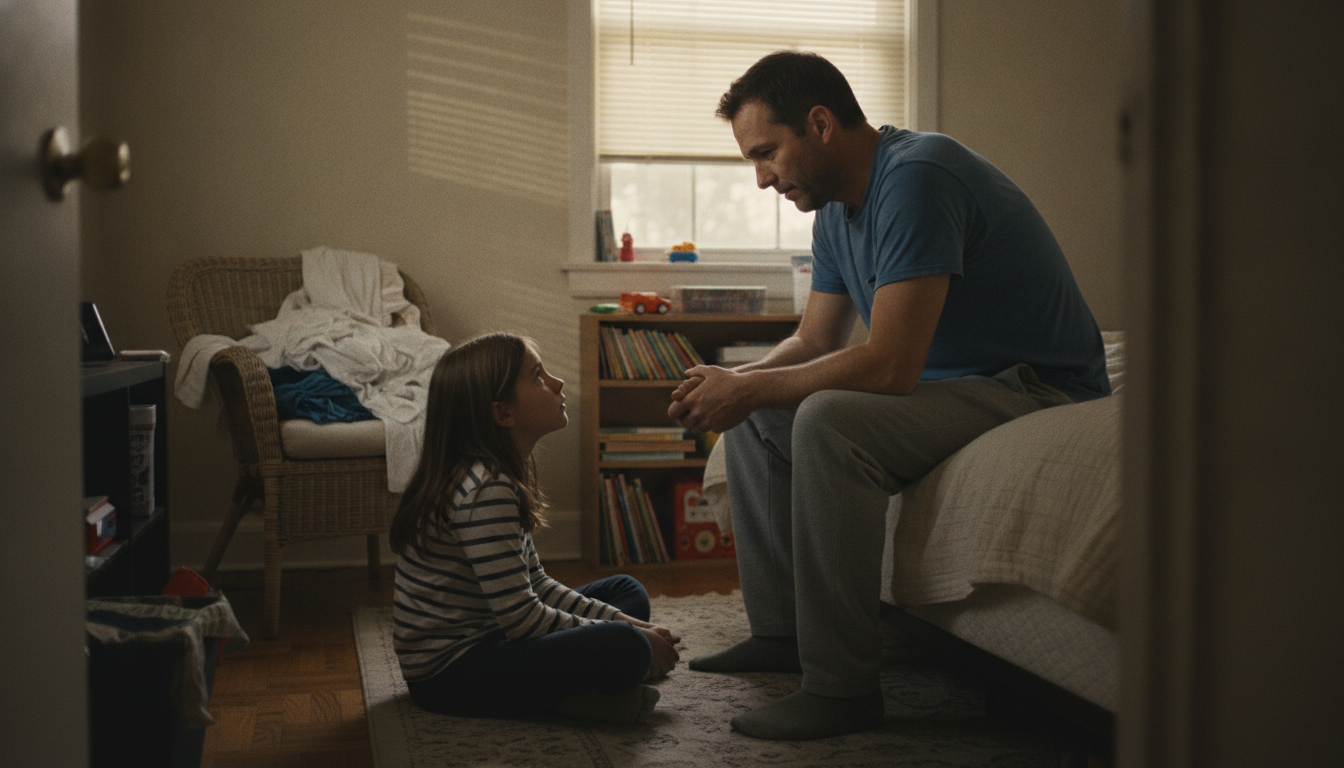
Talking to kids about mental health is one of those things most of us were never taught how to do, because nobody did it for us. We grew up in households where dad’s bad days were explained away as being tired, or stressed about work, or just quiet, and we absorbed the lesson that emotional struggle was something adults managed invisibly, behind closed doors, at considerable personal cost.
We think that era is worth ending. Not through some grand therapeutic declaration at the dinner table, but through small, honest, calibrated conversations that normalize the reality that even the adults running the show have hard days inside their own heads. This piece is about how to actually do that without sending your eight-year-old into an anxiety spiral or turning yourself into your kid’s emotional support animal.
Why This Conversation Is Worth Having at All
The research case for talking to kids about mental health openly is not subtle. A landmark longitudinal study found that children who grow up in households where emotions are discussed openly and without shame develop significantly stronger emotional regulation skills and report higher life satisfaction into adulthood (Gottman et al., 1997). The mechanism is not mysterious: when kids see that feelings are nameable, survivable, and not shameful, they build a framework for handling their own.
There is also a protective effect specific to parental disclosure. Research published in Family Process found that parental psychological openness, meaning parents who acknowledged and discussed their own emotional experiences in age-appropriate ways, was positively associated with lower rates of anxiety and depression in adolescent children (Yap et al., 2014). The kids were not harmed by knowing their parents struggled. They were helped by it.
None of that means you should narrate your depressive episodes in real time over breakfast. Calibration matters enormously, and we will get there. But the foundational premise is sound: your honesty, handled well, is a gift to your kid, not a burden.
The Age-Appropriate Framework That Actually Holds Up
Kids process information differently depending on where they are developmentally, and talking to kids about mental health works best when you meet them where they actually are rather than where you wish they were. A five-year-old and a fourteen-year-old need completely different conversations, even about the same thing you are going through.
Ages 3 to 6: Feelings Have Names, and That Is Enough
At this age, the goal is purely vocabulary and normalization. You are not explaining anxiety disorders or the finer points of cognitive behavioral therapy. You are just giving feelings names and modeling that grown-ups have them too. Something like “Dad is feeling sad today, kind of like when you miss your friend, and I am going to take a little quiet time and then I will feel better” is a complete and sufficient conversation for a four-year-old.
What you are building here is the early architecture of emotional literacy. You are showing them that feelings are identifiable, that they pass, and that they do not have to be hidden. That is genuinely powerful work, and it requires almost nothing from you except the willingness to name what is happening instead of deflecting.
Ages 7 to 11: Cause and Effect, Without the Full Weight
School-age kids are natural detectives. They notice when something is off, and if you do not give them an explanation, they will construct one, and the one they construct is almost always worse than the truth and almost always involves it being their fault. Talking to kids about mental health at this age means giving them just enough context to understand what they are seeing without loading them with adult-level complexity.
“Sometimes my brain gets stuck in a worried loop, kind of like a song you can not stop hearing. It is not about anything you did. I am working on it and I have people helping me” covers a remarkable amount of ground in three sentences. You have named it, cleared them of responsibility, signaled that it is manageable, and modeled help-seeking behavior, all without a single clinical term or an overshare.
This is also the age where kids start asking follow-up questions, so be ready for them. “Will you always feel like that?” and “Can I catch it?” are both common and both answerable honestly. No, not always. And no, you can not catch it the way you catch a cold, though sometimes feelings do run in families, which is why we talk about them.
Ages 12 and Up: More Truth, More Dialogue, More Agency
Adolescents can handle considerably more, and frankly they usually already know more than you think. By twelve, most kids have friends dealing with visible mental health struggles, have encountered the language of therapy and diagnosis in school or online, and have their own internal weather systems that are getting complicated fast. Talking to kids about mental health at this stage can be a real two-way conversation.
You can be more specific here. You can say “I have been dealing with depression on and off for a long time” or “anxiety is something I manage, kind of like how some people manage a bad back.” You can talk about what helps you, what therapy looks like if you are in it, and how you have learned to recognize when things are sliding. What you are modeling at this age is not just that feelings exist, but that adults actively manage them, that asking for help is a normal and smart move, and that struggling does not mean failing.
What to Say Versus What to Carry Alone
There is a real line between appropriate openness and parentification, and it is worth being clear about where it sits. Parentification happens when a child is given emotional responsibility that belongs to an adult. That looks like leaning on your kid for comfort, making them feel responsible for managing your moods, or sharing details that are genuinely above their developmental pay grade. None of that is what we are describing here.
The test we find useful is this: are you sharing to help your child understand their world, or are you sharing because you need to unload? The first is parenting. The second is a job for your therapist, your partner, your bandmates, your close friends, or anyone else in your life who is actually equipped to hold that weight. Your kids love you and they will try to help, which is exactly why you should not ask them to.
Specifics that generally stay on your side of the line include: the severity of your worst episodes, active suicidal ideation (unless a safety plan requires disclosure), substance use details, relationship problems between you and your co-parent, and financial stress connected to your mental health. There is age-appropriate honesty, and then there is just honesty, and only one of those belongs in this conversation.
Timing and Setting Actually Matter
The impulse to have important conversations at the kitchen table, facing each other directly, is understandable but often counterproductive. Direct eye contact during emotionally weighted conversations can feel confrontational or high-stakes to kids, especially boys and especially adolescents. Side-by-side conversations, the kind that happen in the car, on a walk, while you are cooking or shooting hoops, tend to land better because the low-key parallel activity provides just enough psychological distance to make honesty feel safer.
Timing matters too. Right before bed, right before school, or in the middle of an already stressful moment are not the plays. You want a calm window where nobody is rushing anywhere and where you can follow through on whatever the conversation surfaces. If your kid has questions or feelings in response, you want to be available for them, not checking your watch.
When Your Kid Has Their Own Mental Health Struggles
Sometimes the reason talking to kids about mental health feels urgent is not just about your own disclosure. It is because you are watching your kid struggle and you are trying to open a door. If that is the situation, the approach shifts somewhat, because now you are not just modeling openness, you are actively trying to create safety for them to share something they may not have words for yet.
Sharing your own experience in these moments can be genuinely powerful. “I know what it feels like when your brain will not stop or when everything feels too heavy, because I have felt that too” removes a significant amount of shame from the room. It signals that this thing they are experiencing is not a character flaw or a sign that something is permanently wrong with them. It is a thing that happens to people, including people they love and respect, and it is a thing that can be addressed.
This is one area where the work you do on your own mental health, including whatever that looks like for you, whether that is therapy, medication, exercise, community, or some combination, pays dividends beyond yourself. Kids who see their parents actively and unapologetically managing their mental health are measurably more likely to seek help themselves. The modeling is not incidental. It is the whole thing. We have written about how identity shifts after kids arrive and how those shifts can quietly erode the habits that keep us well, and if that resonates, The New Dad Identity Crisis is worth your time.
Talking to Kids About Mental Health When You Are in Crisis
This is the scenario most parents dread, and it deserves direct treatment. If you are in an acute mental health crisis and your kids are in the house and aware that something serious is happening, silence is usually worse than a simple, calm, age-appropriate explanation. Kids fill silence with fear. A brief, reassuring statement, even an imperfect one, is almost always better than nothing.
If you are in that position right now, the 988 Suicide and Crisis Lifeline is available by call or text at any hour. The National Alliance on Mental Illness helpline also offers guidance specifically for families navigating how to talk about mental health across generations. You do not have to figure out the right words alone.
In a genuine crisis, your first job is to make sure you are safe and that your kids are with a trusted adult. The conversation can happen after. What matters most in that moment is not the perfect explanation. It is that the adults in your child’s life are taking care of the situation, and that your kid sees that.
The Long Game: Ongoing Conversation, Not a Single Talk
One of the most freeing realizations about talking to kids about mental health is that it does not have to be a single, significant, sit-down event. It works better as an ongoing low-key thread running through ordinary life. Mentioning that you went to therapy today the same way you would mention going to the gym. Noting when you are practicing something you learned, like catching a thought spiral before it takes hold. Asking your kid about their own emotional weather with the same casual regularity you ask about school.
This normalization over time is where the real protective value lives. When mental health is just another topic in your household, one that gets discussed without drama and without shame, your kids grow up with a completely different starting point than most of us had. They know the vocabulary. They know that struggling does not disqualify you from being a good person or a capable father. They know that help exists and that asking for it is smart, not weak.
We have also found that protecting deliberate time for yourself, not just for mental health maintenance but for identity, feeds directly into how present and honest you can be with your kids. There is a reason we are such advocates for dads having actual hobbies and interests outside of parenthood. Why Every Dad Needs a Hobby gets into that case if you want the full version.
A Few Things Worth Remembering
You are not going to get every one of these conversations right. You will occasionally overshare, or undershare, or pick the wrong moment, or use words your kid stares back at blankly. That is fine. The relationship absorbs it. What your kids are taking in is not the perfect execution of each conversation. It is the cumulative signal that you are someone who talks honestly about hard things, who takes their own wellbeing seriously, and who trusts them enough to let them into parts of your real life.
That signal, repeated across years of ordinary moments, is worth considerably more than any single perfectly crafted talk. Your kids do not need a flawless narrator. They need a real dad, living visibly and honestly, doing the work. That turns out to be more than enough.
References
Gottman, J. M., Katz, L. F., & Hooven, C. (1997). Meta-emotion: How families communicate emotionally. Lawrence Erlbaum Associates. https://psycnet.apa.org/record/1996-98938-000
Yap, M. B. H., Pilkington, P. D., Ryan, S. M., & Jorm, A. F. (2014). Parental factors associated with depression and anxiety in young people: A systematic review and meta-analysis. Journal of Affective Disorders, 156, 8–23. https://doi.org/10.1016/j.jad.2013.11.007