Why Playing an Instrument Makes You a Better Dad (The Neuroscience)
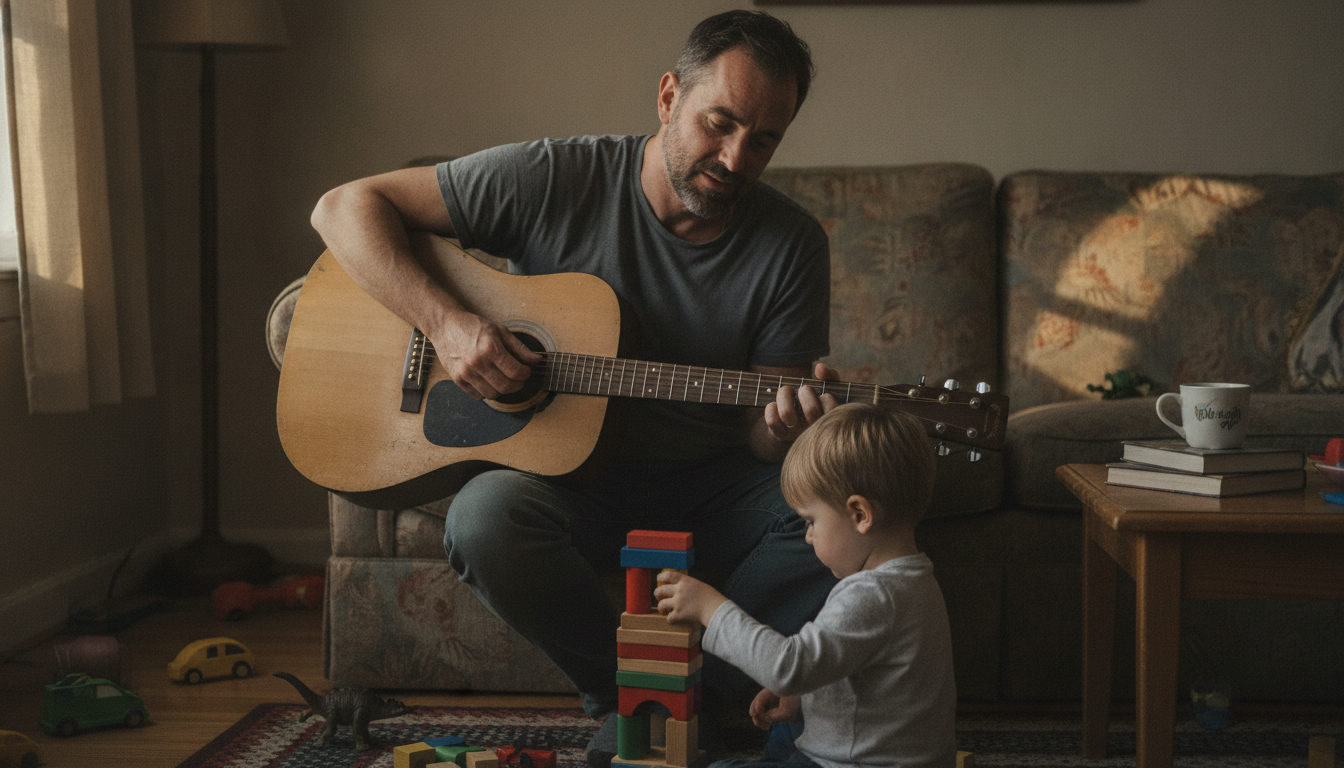
The science of playing music benefits brain development in ways that go far beyond learning chord shapes or reading notation. We are talking about measurable structural changes in the organ that determines how you handle stress, how you listen, how you recover from conflict, and how present you can actually be when your kid needs you. If you have ever picked up a guitar between bedtime routines or sat at a keyboard for twenty minutes after the dishes were done, you were doing something more significant than you probably realized.
This is not a piece about becoming a better musician, and it is definitely not a motivational poster about following your dreams. This is about the hard neuroscience underneath a habit that a lot of dads already have or used to have before life got loud in a different way. The research is genuinely interesting, and the implications for how we show up as fathers are worth taking seriously.
What Actually Happens to Your Brain When You Play
Playing an instrument is one of the most neurologically demanding things a human being can do. A landmark study using fMRI imaging showed that when musicians play, virtually every area of the brain fires simultaneously, including the visual, auditory, and motor cortices, in a way that is qualitatively different from listening to music passively (Wan & Schlaug, 2010). The researchers described it as a full brain workout, which sounds like the kind of thing a wellness brand would invent, except it comes from peer reviewed neuroscience.
What that full-brain engagement produces over time is neuroplasticity. The brain physically reorganizes itself around the demands of playing. The corpus callosum, the bundle of fibers connecting the left and right hemispheres, becomes measurably thicker and better integrated in musicians compared to non-musicians. More cross-hemisphere communication means better problem solving, better emotional processing, and better access to creativity under pressure. That last one is basically the job description of fatherhood.
The Prefrontal Cortex Connection
The prefrontal cortex is the part of your brain responsible for executive function, which includes impulse control, decision making, and the ability to regulate emotional responses before they come out of your mouth at your seven-year-old. Regular musical practice strengthens prefrontal engagement and has been linked to improvements in working memory and attention in adult learners, not just children (Moreno et al., 2011). The takeaway is not subtle: a dad who plays regularly is training the exact neural circuitry that determines whether he reacts or responds when things go sideways at the dinner table.
Working memory improvement is particularly relevant here. When you are holding a chord progression in your head while watching your left hand and listening for timing, you are drilling the same cognitive machinery you use to track multiple children across a crowded park, remember that you promised a specific bedtime story three days ago, and still hold a conversation with your partner. These are not separate skills. They run on the same infrastructure.
Playing Music Benefits Brain Regulation in Ways Parenting Demands
Emotional regulation is the unglamorous core of good parenting. It is the gap between what your kid does and what you do next. It is the pause before the response, the ability to stay grounded when you are running on four hours of sleep and someone just poured juice directly onto the couch cushion. Playing music benefits brain regulation through at least two well-documented mechanisms: stress hormone reduction and the cultivation of what researchers call flow states.
Cortisol suppression during and after musical performance has been documented across multiple study designs. Even amateur musicians show measurable reductions in salivary cortisol following playing sessions, which means the stress the day has loaded onto you is physically, chemically reduced by the act of playing. This is not relaxation in a vague sense. It is a biological reset.
Flow States and Why They Matter Off the Instrument
Flow, the state of deep engagement where time distorts and self-consciousness drops out, was described extensively by psychologist Mihaly Csikszentmihalyi, and musical practice is one of the most reliable ways to access it. What matters for our purposes is not the flow state itself but what practicing entry into flow does to you over time. Regular experience of flow through music appears to lower the baseline arousal level of the nervous system, making it easier to access calm focus in other areas of life. A dad who regularly hits a flow state on a guitar is training his nervous system to downshift, and that training transfers.
This connects directly to what we have written about in pieces like Why Every Dad Needs a Hobby, where the argument is that a pursuit done purely for intrinsic reward is not a luxury but a functional necessity. Music is one of the few hobbies where the psychological benefits are backed by hard neuroscience rather than just self-report data.
Empathy, Listening, and the Skills Nobody Tells You Fatherhood Requires
Here is where it gets genuinely interesting. Playing music in any ensemble context, whether that is a band, a jam session, or even playing along to recordings, requires a specific kind of listening that is different from passive hearing. Musicians have to track their own output while simultaneously monitoring everything around them and adjusting in real time. This is trained auditory attention, and the cognitive habit it builds extends well beyond the instrument.
Research on musical training and empathy has found associations between long-term playing and higher scores on measures of emotional recognition and interpersonal sensitivity. The proposed mechanism is that the sustained practice of listening for subtle variations in tone, timing, and dynamics sharpens the neural systems we use to read other people. If you are used to hearing the difference between a note that is slightly flat and one that is in tune, you are also better trained to hear the difference between what your teenager is saying and what they actually mean.
The Patience Architecture
Learning an instrument as an adult is an extended exercise in tolerating failure, incremental progress, and delayed gratification. You will play a passage wrong dozens of times before it clicks. You will reach a plateau and sit there for weeks. Every single musician who has stuck with it past the beginner stage has been through the experience of wanting to quit and choosing not to, and that process is building something real in the brain’s reward and persistence circuitry.
That architecture of patience is not confined to the instrument. The dad who has ground through learning a difficult chord transition has practiced, in a very concrete way, the act of staying with something hard without immediate payoff. Parenting is that experience on a much longer timeline. The two are not analogous in a poetic sense. They are running on overlapping neural systems.
What This Looks Like in Practice for Actual Dads
We are not suggesting you carve out two hours a day or build a home studio. The research does not require that kind of volume to show benefits. Studies on adult music learners have shown neurological and psychological gains with practice sessions as short as twenty to thirty minutes, provided there is some regularity. Three times a week at the kitchen table after the kids are down is enough to be doing something real.
The identity piece matters here too, and we have written about this directly in the context of The New Dad Identity Crisis. One of the quiet losses of early fatherhood is the erosion of the self that existed before the role. Playing an instrument is one of the most effective ways to maintain a continuous thread of personal identity through that transition, because it is something you do that is entirely yours, that has a history and a trajectory independent of your family role, and that produces a measurable sense of competence outside of parenting.
The Modeling Dimension
There is a secondary effect worth naming plainly. When your kids watch you practice, struggle, improve, and stay committed to something difficult, they are receiving a live demonstration of growth mindset, frustration tolerance, and intrinsic motivation. No conversation about perseverance lands the way a real model does. A dad sitting at a drum kit working the same fill for the fourth time in a row is teaching without a single word.
Research on observational learning in children consistently shows that parental modeling of effortful practice has stronger effects on children’s own persistence behaviors than direct instruction or praise. You do not have to be good at the instrument. Being visibly engaged with getting better is the point. The bar is genuinely that accessible.
The Specific Case for Picking It Back Up
A significant portion of dads in their thirties and forties played something in their teens or twenties and let it go. The guitar went into a case in a closet. The keyboard got moved to a corner and covered with stuff. This is extremely common, and the neuroscience here is actually encouraging rather than discouraging. Adult brains retain motor patterns and musical memory in ways that make re-learning substantially faster than original learning. The procedural memory for chord shapes or drum patterns does not evaporate the way conscious memory does. It is stored differently and it comes back faster than you expect.
The friction of starting is almost always psychological rather than neurological. The internal story is usually some version of I am too old for this now or I do not have enough time to actually get anywhere with it. Both of those are worth interrogating, because the science does not support either. The benefits of playing music for brain health, emotional regulation, and interpersonal capacity begin accruing well before you reach any standard of technical proficiency. You do not need to get anywhere in particular. You just need to play.
A Note on the Research and What It Does Not Claim
It is worth being honest about what the neuroscience does and does not prove. Most studies on musical training and brain structure have been conducted with professional or long-term musicians, which makes causal claims harder to establish for recreational adult players. There is also the persistent question of selection effects: do people with certain neurological profiles self-select into music, or does music create those profiles? The honest answer is probably both, and the research designs that have tried to control for this using adult learners randomized into music training versus control groups have still shown meaningful effects.
The American Psychological Association’s overview of music and brain research and work published through institutions like the Schulich School of Music at McGill University represent some of the more rigorous corners of this field. The short version of their collective finding is that playing music is good for the brain in ways that are not replicated by any other single activity, and the effects are present in adult learners, not just children who start early.
None of that requires you to cite a study the next time you pick up a guitar. It just means that when you do, you are doing something that the evidence takes seriously, even if you are playing the same three chords you learned in 1999.
The Bottom Line
Playing music benefits brain function in ways that map almost directly onto the demands of fatherhood: emotional regulation, patience, empathy, active listening, stress management, and the ability to stay present under pressure. These are not metaphorical connections. They are the outputs of overlapping neural systems being exercised by the same fundamental habit. The instrument in the closet is not a relic of who you were before kids. It might be one of the better tools you have for who you want to be now that you have them.
Pull it out. Tune it up. Play badly for a while. The neuroscience is on your side.
References
Moreno, S., Bialystok, E., Barac, R., Schellenberg, E. G., Cepeda, N. J., & Chau, T. (2011). Short-term music training enhances verbal intelligence and executive function. Psychological Science, 22(11), 1425–1433. https://doi.org/10.1177/0956797611416999
Wan, C. Y., & Schlaug, G. (2010). Music making as a tool for promoting brain plasticity across the life span. The Neuroscientist, 16(5), 566–577. https://doi.org/10.1177/1073858410377805