Starting a Band After 30: A Realistic Guide for Grown-Ups
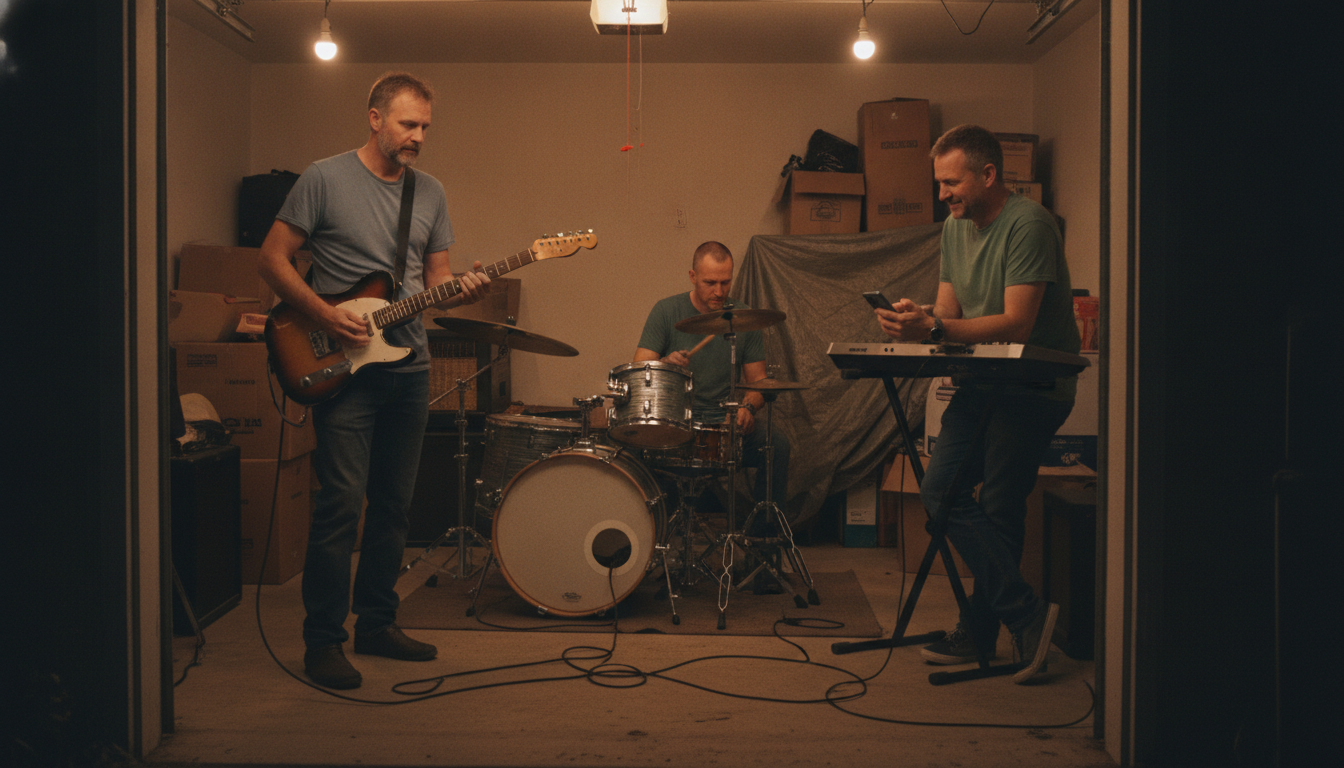
Starting a band as adult is, depending on who you ask, either the most inspired thing you can do with a Tuesday night or the clearest sign you have fully lost the plot. We are here to tell you it is neither. It is something more useful than both: it is a genuinely viable creative project that fits inside a grown-up life, provided you go in with realistic expectations and stop comparing yourself to the version of this you imagined at seventeen.
We started DadCorps well into adulthood, with mortgages and kids and the particular brand of exhaustion that comes from being a present parent. We are not going to pretend that starting a band as adult is the same experience as doing it at nineteen with no responsibilities and unlimited rehearsal time. It is not. But in a lot of ways it is actually better, and we can prove it.
Why Adults Actually Make Better Bandmates
Here is the uncomfortable truth about teenage and early-twenties bands: most of them implode not because of a lack of talent but because of a catastrophic lack of emotional regulation, communication skills, and basic reliability. People miss practice because they are upset about something unrelated. Someone quits over a set list disagreement. Someone else develops an ego precisely calibrated to destroy any collaborative chemistry the group had built. Adults, generally speaking, have been through enough of life to know how to sidestep most of that wreckage.
You also show up to rehearsal knowing what you want. You are not still figuring out who you are as a person while simultaneously trying to figure out who you are as a musician. That clarity is enormously valuable. The creative conversations are faster, the compromises are easier to reach, and nobody is performing their personality for an audience of their future self.
Starting a Band as Adult Means Renegotiating Your Relationship With Time
Time is the actual central challenge here, not skill, not gear, not finding people to play with. If you have kids, a career, and a relationship you want to preserve, the hours available for band activity are finite in a way they simply were not before. The mistake most people make is trying to slot band life into the leftover hours after everything else is handled, and then wondering why it never gains traction. The band has to be scheduled with the same intentionality you schedule anything else that matters.
One weekly rehearsal of two focused hours beats four scattered sessions where half the members show up and nothing gets finished. Treat it like a standing appointment. Put it on the shared family calendar. Communicate with your partner about what the commitment actually looks like before you make it, not after. This is less romantic than the mythology of the band that just spontaneously comes together, but it is how adult bands survive past the first six months.
It is also worth reading what we wrote about why every dad needs a hobby, because the psychological argument for protecting dedicated creative time applies directly here. The band is not a luxury. It is maintenance.
Finding People to Play With After 30
This is the part everyone dreads and it is not as grim as it sounds. The live music ecosystem in most mid-size to large cities is full of adults who used to play and want to play again, or who never stopped and are quietly desperate for people their age to play with. You just have to know where to look, because it is not the same places you looked at twenty-two.
Craigslist musician ads still exist and still work, particularly for adults, because adults are the ones posting on Craigslist. Facebook groups organized around local music scenes or specific genres tend to skew older than platform stereotypes suggest. BandMix and JamKazam have communities specifically built around musicians seeking other musicians. Beyond digital, open mics are underrated for this purpose because they function as a live audition environment where you can observe someone’s playing, their stage demeanor, and crucially, how they behave between songs before you ever spend a rehearsal with them.
The friend-of-a-friend path is honestly the most reliable pipeline. Tell people you are looking. Most musicians know other musicians, and the social friction of joining a group of strangers collapses significantly when someone you already trust made the introduction. We have watched more adult bands form through a casual conversation at a school pickup than through any formal musician-matching platform.
What to Look For in Adult Bandmates
Compatibility of ambition is the most overlooked variable and the one most likely to blow up the project if you get it wrong. Someone who wants to play original music and eventually record an EP has fundamentally different needs than someone who wants to learn covers and play one neighborhood bar gig a year. Neither goal is wrong, but putting those two people in the same band creates a slow-building resentment that eventually ends badly for both of them.
Ask directly, before the first real rehearsal, what someone actually wants out of this. Ask how many hours a week they can realistically commit. Ask whether they have family obligations that affect their availability and whether their household is on board. These feel like uncomfortable questions but they are significantly less uncomfortable than dissolving a band three months in because no one asked them upfront. Adults can have this conversation. Have it.
Gear Expectations When Starting a Band as Adult
One genuine advantage of being an adult with some financial footing is that you can buy decent gear without it being a years-long savings project. One genuine trap of being an adult with some financial footing is buying significantly more gear than you need before you have established that the band is actually going to stick. We have watched people spend thousands on a rehearsal rig for a project that dissolved after four sessions. Buy what you need to participate fully, not what you might need if everything goes perfectly.
For a rehearsal situation, the actual minimum is your primary instrument in playable condition, an amp if you are a guitarist or bassist that can be heard over a live drum kit, and whatever accessories are specific to your instrument. A solid digital audio workstation subscription for home practice and demo recording costs very little and returns a great deal. Everything else is iterative. Buy it when the project earns it.
If you are rehearsing in a space with noise constraints, which is most of us, low-wattage amps and electronic drum kits have gotten genuinely good. The technology for apartment or garage practice that does not wreck your neighbor relationships or your family’s sanity has never been better. This is one area where starting a band as adult in the current era is objectively easier than it would have been fifteen years ago.
Original Music vs. Covers: A Non-Judgmental Breakdown
Both paths are legitimate and both have real tradeoffs. Cover bands are easier to get to a performance-ready state because the material already exists and audiences already know what they are about to hear. They can also generate actual income relatively quickly if you are targeting weddings, private events, or bars that book live music, which means the band can pay for itself in gear and rehearsal space without any of the members dipping into their own pockets past a certain point.
Original music is slower, harder to build an audience for, and requires more from everyone creatively. It is also, for a lot of people, the entire point. If writing and recording your own material is what made you pick up an instrument in the first place, a cover band is going to scratch a different itch than the one you actually have. Be honest with yourself about which of these you are actually chasing before you recruit anyone, because it shapes every decision that follows, from how you write your musician-wanted ad to how you structure rehearsals to what success looks like in year two.
There is also a hybrid model that a lot of adult bands land on organically: a working set of covers for live performance paired with a slow, patient process of writing original material on the side. This keeps the band gigging and earning while the original catalog develops at whatever pace adult life actually allows. It is not a compromise so much as a practical architecture.
Managing the Household Politics of Band Life
This section exists because ignoring it is how band life becomes a source of genuine tension in a relationship rather than something your partner is even cautiously enthusiastic about. The time you spend rehearsing, gigging, or recording is time someone else is managing the household and the kids. That is a real cost and it deserves to be acknowledged directly rather than treated as a given.
The conversations worth having before the band gets rolling: what is the weekly time commitment, what does a gig night look like logistically, what is the financial investment and what is the ceiling on that, and what does the band get to grow into versus what stays bounded. These are not restrictions on your creative life. They are the foundation that lets your creative life exist sustainably inside your actual life rather than in spite of it. The new dad identity crisis piece we wrote touches on how identity and partnership intersect when you are trying to hold onto something that is yours in the middle of a life built around other people. The dynamics there apply here more than you might expect.
Reciprocity matters. If band night is Thursday, make sure your partner has an equivalent protected time for whatever they need. This is not transactional in a cold way. It is just the basic fairness architecture that keeps resentment from accumulating in the background of an otherwise good partnership.
Setting Goals That Actually Make Sense
Starting a band as adult requires a different relationship with ambition than the one the music industry mythology hands you. You are probably not going to tour. You are probably not going to build a following large enough to support the band financially in any meaningful way, at least not in the first few years. If those are the only metrics you are using to measure whether this was worth doing, you are going to find reasons to quit before the project gets genuinely good.
The goals that tend to sustain adult bands are smaller and more concrete: finish writing five original songs, record a demo, play one live show, get to the point where the set sounds the way you heard it in your head when you started. These are achievable within the actual constraints of adult life and they create a chain of small wins that keeps everyone motivated between the bigger milestones that take longer to arrive.
Quarterly reviews with your bandmates, informal as that sounds, are genuinely useful. Thirty minutes every three months where you talk honestly about what is working, what is not, and whether the shared goals are still shared. This is a practice borrowed from the professional world that adult musicians can actually execute because they have the self-awareness and communication skills to have that conversation without it becoming a confrontation.
The First Gig and What It Actually Teaches You
Book a show before you feel ready. This is consistent advice across virtually every experienced musician we have encountered and it is correct. There is a rehearsal ceiling, a point at which playing the same songs in the same room produces diminishing returns because the actual challenge of live performance is categorically different from the challenge of rehearsal. Adrenaline changes how you play. An audience changes how you communicate with your bandmates. The monitors, the room acoustics, the three seconds of dead air between songs while someone adjusts a cable, none of that exists in a garage, and the only way to learn how to handle it is to stand in it.
Start small and sensible. An open mic, a bar with a low-pressure Tuesday slot, a house show, a fundraiser for something in your community. The goal of the first show is not to be impressive. The goal is to survive it, debrief honestly afterward, and use what you learned. The second show will be better. The third show will be better than that. This is how it works for everyone, regardless of age or experience, and knowing that going in takes a significant amount of pressure off the first night.
The Actual Case for Doing This
We want to be clear that we are not arguing everyone should start a band. That would be exactly the kind of prescriptive enthusiasm we do not traffic in. But if you have been thinking about it, if the idea keeps surfacing when you hear a song that hits the right frequency or when you find yourself watching live footage of a band you love, the thinking is worth taking seriously rather than filing under things I would have done if my life had gone differently.
Starting a band as adult is a decision to build something collaborative and creative inside a life that could very easily go years without either. It is a decision to stay in a relationship with music that is active rather than passive. And it turns out that the skills adult life has given you, patience, self-awareness, the ability to show up consistently to things that matter, are exactly the skills that make bands work. The seventeen-year-old version of you would have been terrible at this for reasons that had nothing to do with talent. You are not that person anymore. Use it.