The 20-Minute Dad Workout: Full Body Training When Time Is Not on Your Side
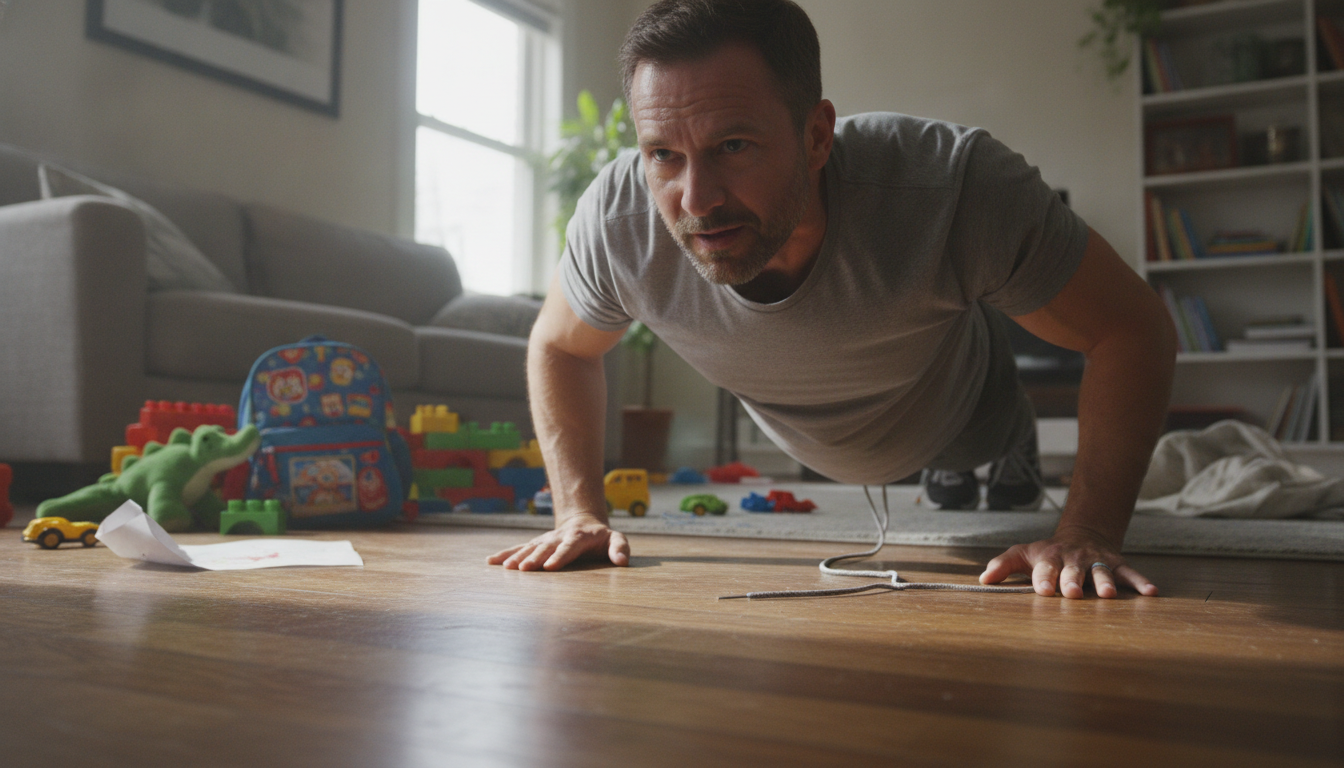
A quick workout for dads is not a consolation prize. It is not the sad little compromise you make when “real” training is off the table. If you have twenty minutes and a floor to stand on, you have enough to do meaningful, research-supported work on your cardiovascular system, your muscle tissue, and your stress response. We are going to show you exactly how to use those twenty minutes before they disappear into the morning chaos.
The myth that shorter workouts are not worth your time is persistent, and it is wrong. A quick workout for dads built around compound movements and minimal rest periods can produce genuine adaptations in strength and aerobic capacity, and the science backing that up is not thin. This is not a motivational speech. This is a training plan.
Why 20 Minutes Is Actually Enough
Fatherhood does not shrink your physiology. Your muscles still respond to progressive overload, your heart still adapts to elevated demand, and your endocrine system still rewards hard effort with a favorable hormonal environment. What fatherhood does shrink is your available time, and that is a logistics problem, not a biology problem.
Research supports the legitimacy of short, high-effort sessions, with some honest fine print. A review of low-volume, high-intensity interval training in the Journal of Physiology concluded that brief interval sessions, involving far less total exercise time than traditional endurance training, can improve muscle metabolism and cardiovascular function to a degree comparable to moderate continuous exercise, although the authors noted that evidence in people with or at risk of conditions like type 2 diabetes was still limited (Gibala et al., 2012). On the strength side, a meta-analysis in the Journal of Sports Sciences found a graded dose-response relationship between weekly training volume and muscle growth, meaning more weekly sets per muscle generally produced more growth (Schoenfeld et al., 2017). That cuts both ways for a short program: every set you do counts, and doing this circuit several times a week matters more than any single session. You do not need an hour. You need effort and consistency.
The twenty-minute window also has a psychological advantage. It is short enough that you cannot talk yourself out of it on most days. The activation energy required to commit to a twenty-minute session is genuinely lower than committing to an hour, and that matters enormously for adherence over months and years.
The Structure of a Quick Workout for Dads
We are organizing this around a circuit format: five compound movements, performed back to back with short rest, cycling through multiple rounds. Compound movements are non-negotiable here because they recruit the largest muscle groups simultaneously, which means more metabolic output per unit of time. Isolation work is a luxury when you have unlimited training hours. You do not have unlimited training hours.
The format is two minutes of movement followed by thirty seconds of rest between exercises, targeting three to four full rounds depending on your current fitness level. Your total working time lands right at twenty minutes including a brief warm-up. No equipment is required for the baseline version, though we will note where adding a set of dumbbells or a resistance band significantly increases the stimulus.
The Warm-Up: 2 Minutes, Not Optional
Skipping the warm-up when you only have twenty minutes is tempting and counterproductive. Two minutes of dynamic movement raises your body temperature and gets your joints moving through the ranges you are about to load, and that is worth the investment every single time. Spend thirty seconds each on leg swings, hip circles, arm circles, and inchworms. Move with intention, not haste.
The Five Movements
1. Squat Variation
Bodyweight squats, jump squats, or goblet squats if you have a dumbbell or kettlebell available. The squat is the foundation of lower body training because it loads the quads, hamstrings, glutes, and core in a single pattern. Drive through your heels, keep your chest tall, and hit full depth if your mobility allows. Aim for fifteen to twenty reps per round of bodyweight squats, or eight to twelve reps if you are adding load.
If you are several months into consistent training and bodyweight squats have stopped being a challenge, jump squats add a plyometric demand that will immediately raise your heart rate and re-introduce an overload stimulus. Land soft, reset, repeat.
2. Push-Up Variation
The push-up is one of the most misunderstood exercises in existence. Most people treat it as a beginner move to graduate past, when in reality a properly performed push-up with full scapular engagement, a rigid plank position, and complete range of motion is legitimately challenging and trains the chest, anterior deltoids, triceps, and core together. If standard push-ups are too easy, elevate your feet or add a pause at the bottom. If they are currently too difficult, drop to your knees temporarily while you build strength, but treat it as a temporary measure and track progress aggressively.
Target ten to twenty reps depending on your variation. Rest only the thirty seconds between exercises. The compounding fatigue across rounds is part of the design.
3. Hip Hinge
Single-leg Romanian deadlifts, good mornings, or a standard hip hinge pattern with or without load. The posterior chain, which means your hamstrings, glutes, and lower back, is chronically underdeveloped in most fathers because we spend enormous amounts of time seated, hunched over car seats, and carrying children in suboptimal positions. Training the hip hinge directly counteracts that pattern and builds the structural integrity to keep you out of a physical therapist’s office.
With no equipment, a bodyweight single-leg Romanian deadlift done slowly and deliberately is genuinely hard and highly effective. Hinge at the hip, keep the back flat, feel the hamstring load before you return to standing. Ten reps per leg per round.
4. Pulling Movement
This is the trickiest exercise to program without equipment, and it is also the most important one to include. The pulling pattern trains the upper back, rear deltoids, and biceps, and it is the structural counterbalance to all the pushing patterns in modern dad life, including the bench press if you do that, but also steering wheels, strollers, and every hunch over a desk or phone. A resistance band anchored to a door handle makes rows immediately accessible. A doorframe pull-up bar makes this trivial. If you genuinely have nothing, a towel-over-a-door-handle inverted row works surprisingly well.
If pull-ups are in your repertoire, do as many as clean form allows per round. If you are working with a band, aim for fifteen rows per round with a two-second squeeze at the peak contraction.
5. Core Anti-Rotation or Anti-Extension Movement
Not crunches. We are not doing crunches. The core functions primarily as a stabilizer, and the exercises that train that function most effectively are those that resist movement rather than create it. Planks, dead bugs, hollow body holds, and Pallof presses all fit this category. A thirty to forty-five second plank held with maximal tension through every muscle in your body is a complete core training stimulus, and if you find a forty-five second plank easy, you are almost certainly not squeezing hard enough or you need to move to a more challenging variation like a plank with shoulder taps or an RKC plank.
The dead bug deserves more credit than it gets. Lying on your back, opposite arm and leg extended simultaneously while maintaining a flat lumbar spine, it directly trains the deep stabilizing system and has carryover to every other movement in this circuit.
Putting the Rounds Together
Complete one exercise, rest thirty seconds, move to the next. After finishing all five exercises, rest ninety seconds and begin the next round. Beginners should target three rounds. If you are already training regularly and this is a time-compressed session substituting for a longer workout, push for four rounds and tighten the rest intervals. The total session including warm-up will fall between eighteen and twenty-two minutes.
Track your reps each session. Progressive overload is the mechanism of adaptation, and you cannot progressively overload what you are not measuring. A note in your phone’s calendar, a whiteboard in the garage, a proper training log, whatever system you will actually use is the right system. The goal is that each week, at least one number goes up somewhere.
The Consistency Variable Nobody Wants to Talk About
Here is the part that most fitness content skips because it is not exciting: a quick workout for dads done four times a week for six months will produce dramatically better results than a perfect program done eight times and then abandoned. Consistency is the primary training variable for anyone managing the actual demands of fatherhood, and it outweighs program optimization at almost every level of experience below advanced.
This connects directly to something we have written about before at DadCorps. The identity shift that comes with having kids can make it genuinely difficult to hold onto the version of yourself that trained, played sports, or just moved regularly before children arrived. If that resonates, our piece on the new dad identity crisis goes deeper into why that happens and how to start reclaiming the non-dad parts of who you are, including the physical ones.
Physical consistency may pay off for your head as well as your body. A meta-analysis of six randomized trials in 262 adults diagnosed with anxiety or stress-related disorders found that exercise reduced anxiety symptoms more than control conditions did (Stubbs et al., 2017). That study looked at people with diagnosed conditions, not dads in general, but calm is in short supply for fathers of young children, and a regular training habit is a reasonable thing to try. Exercise is not a replacement for mental health support when that support is genuinely needed, so if you are struggling, talk to your doctor or a mental health professional, and treat the workout as one helpful, low-cost habit alongside that care.
When to Do It and How to Protect the Time
The answer to when is almost always before the house wakes up or during a defined window that you treat as non-negotiable. Lunch breaks work for some dads. Nap windows work for stay-at-home dads when the stars align. But for most of us, the early morning slot is the one that is least vulnerable to disruption from work schedules, child schedules, and the general entropy of family life.
The logistics of being home with kids full time create a different set of challenges around carving out training time, and if that is your situation, we have some tactical thinking in our guide on the realities of being a stay-at-home dad in 2026 that is worth reading alongside this one.
The most important logistical move you can make is reducing the friction of starting. Lay out your clothes the night before. Know exactly which variation of each exercise you are doing before you start. Do not make decisions when you are half asleep at five in the morning. The session should be so well planned that your brain barely has to engage to begin it.
Scaling This Workout Over Time
The twenty-minute format is not a permanent ceiling. It is a floor you can build from. As your fitness improves and the existing stimulus stops producing adaptation, you have several options that do not require blowing up the time constraint. You can increase the load on the squat and hinge patterns by adding dumbbells or a backpack weighted with books. You can increase the difficulty of the push-up by elevating your feet or wearing a weighted vest. You can shorten the rest intervals from thirty seconds to fifteen. You can add a sixth movement, a loaded carry or a jump rope interval, and still stay inside twenty-two minutes.
What you want to avoid is a program that never changes because change is uncomfortable. Adaptation requires a changing stimulus, and a quick workout for dads that stays identical week after week for six months is eventually just movement maintenance, which has value but is not the same as training.
Nutrition Around a Short Workout
You do not need a complex peri-workout nutrition protocol for a twenty-minute session. What you do need is to not train in a deeply depleted state if you can avoid it, and to eat enough protein across the day to support the muscle building your training is asking for. A meta-analysis of 49 trials with 1,863 healthy adults doing resistance training found that total protein intakes above about 1.6 grams per kilogram of bodyweight per day (roughly 0.7 grams per pound) produced no further gains in muscle mass on average, with a wide confidence interval that stretched to about 2.2 grams per kilogram, or about 1 gram per pound (Morton et al., 2018). For a 185-pound dad, that range works out to roughly 130 to 185 grams spread across meals, not slammed into a single post-workout shake. If you have kidney disease or another medical condition that affects your diet, check with your doctor before raising your protein intake.
If you train first thing in the morning and eating beforehand is impractical, a twenty-minute session before breakfast is unlikely to be a problem for most healthy adults, provided you eat enough across the rest of the day. If you feel lightheaded or weak when you train on an empty stomach, or if you have diabetes or take medication that affects your blood sugar, eat something small first and talk to your doctor about what works for you. Otherwise, do not let the nutrition question become a reason to delay starting.
The Honest Disclaimer
Twenty minutes four times a week will not turn you into a competitive powerlifter or a stage-ready physique athlete. If those are your goals, you need more volume and more time, and that is a legitimate choice if you can build the schedule to support it. But for the average dad who wants to be strong enough to play with his kids without getting winded, maintain a reasonable body composition, manage stress, sleep better, and carry some physical capacity into his fifties and sixties, this format is not a compromise version of fitness. It is a legitimate, evidence-informed approach to maintaining and building health under real constraints. One more piece of honest fine print: if you have been inactive for a long time, or you have a heart condition, high blood pressure, joint problems, or any other health concern, check with your doctor before you start, and stop and get checked if you feel chest pain, dizziness, or unusual shortness of breath during a session.
The goal is not to optimize. The goal is to show up, do the work, and still have enough left over to be present for the rest of the day. That is a worthy goal, and a quick workout for dads built around these five movements and this structure is one of the most reliable ways we know to achieve it.
References
Gibala, M. J., Little, J. P., MacDonald, M. J., & Hawley, J. A. (2012). Physiological adaptations to low-volume, high-intensity interval training in health and disease. The Journal of Physiology, 590(5), 1077-1084. https://doi.org/10.1113/jphysiol.2011.224725
Morton, R. W., Murphy, K. T., McKellar, S. R., Schoenfeld, B. J., Henselmans, M., Helms, E., Aragon, A. A., Devries, M. C., Banfield, L., Krieger, J. W., & Phillips, S. M. (2018). A systematic review, meta-analysis and meta-regression of the effect of protein supplementation on resistance training-induced gains in muscle mass and strength in healthy adults. British Journal of Sports Medicine, 52(6), 376-384. https://doi.org/10.1136/bjsports-2017-097608
Schoenfeld, B. J., Ogborn, D., & Krieger, J. W. (2017). Dose-response relationship between weekly resistance training volume and increases in muscle mass: A systematic review and meta-analysis. Journal of Sports Sciences, 35(11), 1073-1082. https://doi.org/10.1080/02640414.2016.1210197
Stubbs, B., Vancampfort, D., Rosenbaum, S., Firth, J., Cosco, T., Veronese, N., Salum, G. A., & Schuch, F. B. (2017). An examination of the anxiolytic effects of exercise for people with anxiety and stress-related disorders: A meta-analysis. Psychiatry Research, 249, 102-108. https://doi.org/10.1016/j.psychres.2016.12.020