Running for Dads: A Couch-to-5K Guide That Respects Your Schedule
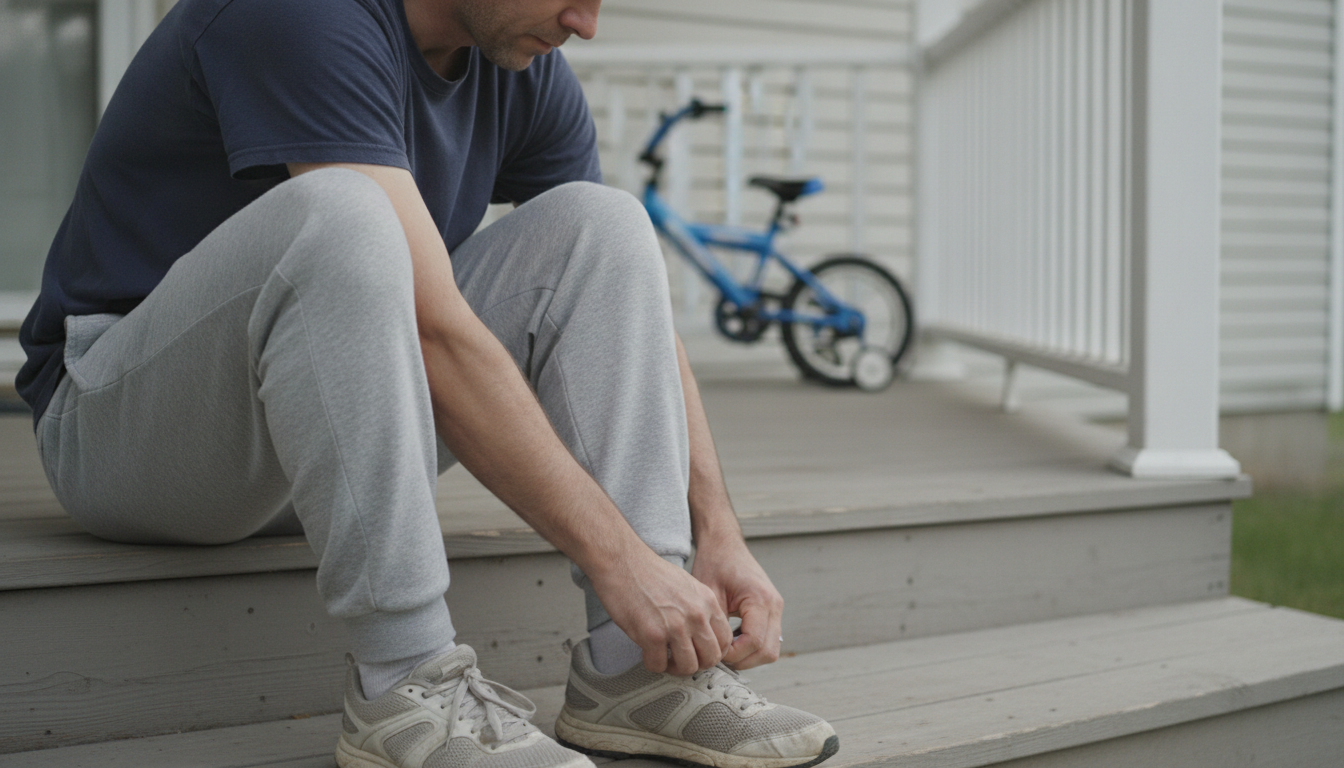
We are a band of dads who read the research, not clinicians. Nothing in this article is a substitute for a doctor or licensed therapist, and you should get medical clearance before starting any new exercise program, especially if you have been sedentary for an extended period.
You do not need a perfect morning. You do not need sixty minutes of uninterrupted quiet, a gym membership, or the motivation of a twenty-two-year-old. What a couch to 5k for dads actually requires is about twenty-five minutes, three times a week, and the willingness to look slightly ridiculous jogging past your neighbor’s house. That is a genuinely low bar, and the research on what that small investment buys you is encouraging, as we will get into below.
This guide is built around the reality of a busy dad’s schedule, which is to say it is built around a schedule that does not really exist in any stable form. It will tell you what the research actually says, give you a week-by-week plan you can follow, and be honest about where things get hard.
Why Running Works Especially Well for Time-Strapped Fathers
Running has a gear-to-benefit ratio that almost nothing else can touch. You need shoes. You walk out the door. Compare that overhead to a gym commute, a class schedule, or assembling a squat rack in your garage. For dads operating on stolen time between drop-off and a work call, or between bedtime and sleep, that simplicity is not a minor perk. It is the whole point.
The cardiovascular case is also strong. Lee et al. (2014) followed 55,137 adults from the Aerobics Center Longitudinal Study for an average of fifteen years and found that runners had lower risks of dying from any cause and from cardiovascular disease than non-runners. The association held even for people running only five to ten minutes a day at slow speeds, the lower risk looked broadly similar across the whole range of weekly running time, and the people who kept running over the years showed the biggest drop of all. Because this was an observational cohort study, it shows an association rather than proof that running alone did the work, but the takeaway maps neatly onto dad life: a little running, kept up over time, appears to count for more than most of us would guess.
There is also a compelling mental health angle, which for a lot of dads is the more urgent reason to start. In a randomized controlled trial, Blumenthal et al. (2007) assigned 202 adults with major depressive disorder to sixteen weeks of supervised group exercise, home-based exercise, the antidepressant sertraline, or a placebo pill. By the end, remission rates were 45 percent for supervised exercise, 40 percent for home exercise, 47 percent for sertraline, and 31 percent for placebo. The authors concluded that exercise looked broadly comparable to medication and that both tended to do better than placebo, although that edge over placebo fell just short of statistical significance and the placebo group improved quite a bit too, which says something about how much attention and expectation matter. That is not a miracle cure, but it is a serious finding. A lot of us got into fitness because the alternative was a slow erosion we were not fully naming. Running gives you a place to put some of that.
If you want more context on why carved-out personal time matters structurally for dads, we wrote about that in the context of why every dad needs a hobby, and the reasoning overlaps significantly here.
Before You Run a Single Step
Get medical clearance. That is not a liability hedge, that is genuine advice. If you are over 40, have been sedentary for more than a year, have any history of cardiac issues, joint problems, or metabolic conditions, a quick conversation with your physician before lacing up is the smart play. The Physical Activity Readiness Questionnaire (PAR-Q) is a free, widely used screening tool available through the Canadian Society for Exercise Physiology at csep.ca and takes about ninety seconds to complete. It is a reasonable first filter.
Shoes matter more for injury prevention than for performance. You do not need the most expensive option on the market, but you do need something that fits your foot type and gait. A specialty running store with a staff member who can watch you walk or jog briefly is worth one visit. It takes twenty minutes, and a shoe that actually fits removes one more reason for the aches that derail a lot of beginner programs somewhere around weeks three through five.
Decide on your time slot before you begin week one. Psychologists call this an implementation intention, which is the formal term for deciding in advance exactly when and where you will perform a behavior, and a meta-analysis of 94 independent tests by Gollwitzer and Sheeran (2006) found that forming one had a medium-to-large positive effect on whether people reached the goal they had set. Pick a specific window: 5:45 AM before the house wakes up, the lunch hour on Tuesday and Thursday, after school drop-off on Monday, Wednesday, and Friday. Write it down somewhere you will see it. Vague intentions dissolve on the first week you run short on sleep.
The Couch to 5K for Dads Plan: 8 Weeks, 3 Days Per Week
This plan is adapted from the general run-walk interval structure that has underpinned couch to 5k programs since the late 1990s. Each session begins with a five-minute brisk walk to warm up and ends with a five-minute easy walk to cool down. The intervals listed are the running portions. Keep your pace conversational, meaning you should be able to say a full sentence while running without gasping. If you cannot, slow down. Speed is irrelevant right now.
Weeks 1 and 2: Building the Base
Alternate 60 seconds of running with 90 seconds of walking for a total of 20 minutes of intervals. Three sessions per week. Your total time per session including warm-up and cool-down is roughly 30 minutes. Week 2 repeats the same structure. This is intentional. The standard coaching logic is that your heart and lungs adapt faster than your connective tissue, which means the runs can feel easier before your tendons and joints have actually caught up. Staying at week 1 intensity for two weeks is a cheap way to give your legs that time and to dodge the shin splints that sideline a lot of new runners.
Weeks 3 and 4: Extending the Runs
Week 3 alternates 90-second runs with 90-second walks, then 3-minute runs with 3-minute walks, repeated twice. Week 4 shifts to 3-minute runs, 90-second walks, 5-minute runs, 2.5-minute walks, repeated twice. You will notice the walking breaks getting shorter relative to the running intervals. That shift in ratio is the core mechanism of the whole program. The goal is not to run faster. It is to spend more of each session actually running rather than recovering.
Weeks 5 and 6: The Mental Barrier
Week 5 is where most people quit, and it is also where the program makes its biggest ask. By mid-week 5, you are running 20 minutes continuously for the first time. If that feels impossible, you are probably running too fast. Slow down to a pace that feels almost embarrassingly easy and hold it. Week 6 continues to build continuous running time with one interval day early in the week and two continuous runs of 22 and 25 minutes toward the end. These are the sessions that genuinely transform your aerobic base.
Weeks 7 and 8: Finishing the Job
Weeks 7 and 8 are 25-minute, 28-minute, and 30-minute continuous runs, each session separated by a rest day. By this point the habit is largely in place, which is the outcome that actually matters more than the 5K distance itself. A 5K is roughly 3.1 miles. If you finish week 8 and cannot quite cover that distance in 30 minutes, that is fine. You will cover it at a run-walk pace and sign up for a race anyway, which is a legitimate finishing line for this program.
Fitting Three Runs Into a Week That Has No Room
The most common version of the couch to 5k for dads problem is not physical. It is logistical. Three committed sessions per week sounds like nothing until you map it against school pickups, dinner, a partner’s schedule, a work deadline, and the baseline exhaustion of parenthood. Here is how we think about it practically.
Treat run days like appointments, not like intentions. Put them on your calendar the same way you would put a dentist appointment or a work call. This is the implementation intention idea from earlier put into practice, and common sense backs it up too. Things that live only in your head tend to stay there.
Two early morning runs and one weekend run is a structure that works for a lot of dads because it concentrates the discipline-heavy sessions at the start of the week and gives you a lower-stakes session on Saturday or Sunday when schedule flexibility is slightly higher. You do not need all three runs to happen before 6 AM. You just need them to happen on a predictable cycle.
On days when the window you planned simply disappears, 20 minutes is better than nothing. Weeks 1 through 4 sessions are short enough that you can complete the core interval block on a genuinely compressed timeline. On those days you can trim the warm-up and cool-down to three minutes each, as long as you keep the first few minutes of running genuinely easy. Give yourself permission to do the imperfect version on hard weeks rather than skipping.
We have a broader conversation about this tension between identity and available time in our piece on the new dad identity crisis, which is worth reading if the question underneath the question here is whether you are allowed to take this time for yourself.
The Physiology of Soreness and When to Stop
Delayed onset muscle soreness, the kind that peaks 24 to 48 hours after a run, is a normal training response and is not a reason to skip the next session. Easy running on mildly sore legs is generally fine, and plenty of runners find that gentle movement loosens things up faster than sitting on the couch. What is not normal is sharp, localized pain that gets worse as a run progresses, pain that radiates, or pain that is still present and unchanged three days after it started.
Your stop rules are simple. Stop running if you feel chest pain, dizziness, or shortness of breath that is out of proportion to your effort. Stop running if you feel sharp or spreading pain in any joint, particularly the knee, hip, or ankle. Walk it off, note exactly where it is and what it feels like, and see a professional if it persists beyond 48 to 72 hours. Shin splints, IT band syndrome, and plantar fasciitis are among the injuries beginners run into most often, and all three are much easier to manage when caught early. They become significant problems when runners try to train through them.
Your starting dose for this program is three sessions in week one, each one no longer than 30 minutes door to door. That is it. Do not add extra days because you feel good in week two. Tendons and joints generally take longer to adapt than your heart and lungs do, and doing too much too soon is one of the classic ways beginners get hurt in weeks two and three.
Nutrition, Sleep, and the Recovery Side of the Equation
At the intensity and duration of a beginner running program, you do not need specialized sports nutrition. What you do need is enough protein to support the muscle repair that follows any new training stimulus, and enough carbohydrate to fuel runs that will start extending past 20 minutes in weeks five and six. If you are already eating reasonably well, the main adjustment most dads need is hydration: drink water before, during if runs exceed 30 minutes, and after each session.
Sleep is where recovery actually happens, and it is also the resource that dad life tends to erode most aggressively. This creates a real tension with early morning running, which is worth naming honestly. Trading sleep for a run is a bad trade in the early weeks when your body is adapting to a new training load. If getting up at 5:30 AM means you are operating on five hours regularly, the lunch or evening window is genuinely the better option, even if the logistics are harder.
Post-run recovery for the beginner program is straightforward: five minutes of walking at the end of each run, gentle static stretching for the calves, hamstrings, and hip flexors held for 30 seconds each, and adequate fluid intake. Foam rolling the calves and the outside of the thigh after sessions longer than 20 minutes is something a lot of runners swear by for soreness, though whether it prevents injuries is a much less settled question. It costs you five minutes and the investment is usually worth it.
Picking a Race to Anchor the Program
Signing up for a 5K race before you finish week one is not hubris. It is a behavioral commitment device, and a meaningful one. A race date on the calendar transforms the program from an open-ended intention into a finite project with a deadline. Search for local 5K events in your area at runningintheusa.com or through your city’s parks and recreation department. Eight weeks from your start date is the target, but a race that lands in weeks nine or ten gives you a small buffer if you need to repeat a week.
Community races tend to be genuinely welcoming environments. Most couch to 5k for dads participants are startled to discover that finishing times range wildly, that there is almost always a substantial walking contingent, and that nobody at a local 5K is scrutinizing your pace. The social reality of these events is far less intimidating than the mental image most beginners carry into their first one.
When to See a Professional
See your physician before starting if you have cardiovascular risk factors, are over 45 and have been sedentary for more than a year, or have any existing musculoskeletal condition. See a sports medicine physician or physical therapist if you develop pain that persists beyond 72 hours, if you notice swelling in any joint following a run, or if you experience any of the stop-rule symptoms listed above. See a mental health professional if the underlying driver for wanting to start this program is more than run-of-the-mill stress and you are struggling in ways that feel bigger than fitness can address. Running helps. It is not a clinical intervention.
References
Blumenthal, J. A., Babyak, M. A., Doraiswamy, P. M., Watkins, L., Hoffman, B. M., Barbour, K. A., Herman, S., Craighead, W. E., Brosse, A. L., Waugh, R., Hinderliter, A., & Sherwood, A. (2007). Exercise and pharmacotherapy in the treatment of major depressive disorder. Psychosomatic Medicine, 69(7), 587-596. https://doi.org/10.1097/PSY.0b013e318148c19a
Gollwitzer, P. M., & Sheeran, P. (2006). Implementation intentions and goal achievement: A meta-analysis of effects and processes. Advances in Experimental Social Psychology, 38, 69-119. https://doi.org/10.1016/S0065-2601(06)38002-1
Lee, D. C., Pate, R. R., Lavie, C. J., Sui, X., Church, T. S., & Blair, S. N. (2014). Leisure-time running reduces all-cause and cardiovascular mortality risk. Journal of the American College of Cardiology, 64(5), 472-481. https://doi.org/10.1016/j.jacc.2014.04.058