Back Pain and Fatherhood: Why Your Back Hurts and What Actually Helps
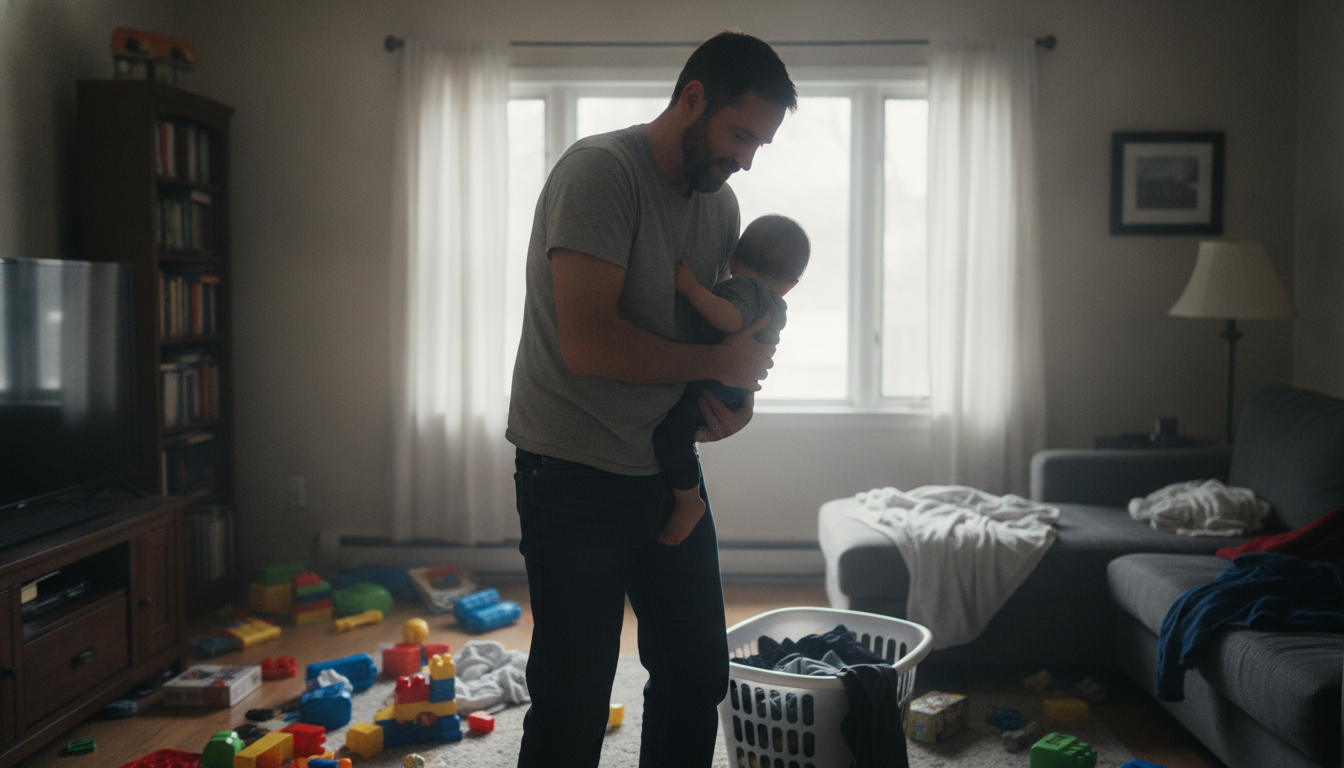
Back pain from carrying kids is not a rite of passage you just accept, even though most of us do exactly that for years before we think to do anything about it. If your lower back has been quietly wrecking you since your kid hit the 20-pound mark, you are not alone, and more importantly, you are not stuck. There is a real physiological story behind why fatherhood is so hard on the spine, and there is solid evidence pointing toward what actually moves the needle on relief.
We put this piece together because back pain from carrying kids kept coming up in our community, usually framed as some unavoidable tax on parenthood. It is not. It is a biomechanical problem with biomechanical solutions, and understanding the mechanism is the first step toward doing something useful about it.
One thing up front: we are a band of dads who read the research, not clinicians. Treat this as a well-sourced starting point for a conversation with your own doctor or physical therapist, not a substitute for one, especially if you are in the middle of a flare.
The Actual Reason Your Back Hurts
When you carry a child, especially on one hip the way nearly every parent does by default, you are doing something genuinely strange to your spine. You are loading an asymmetric weight onto a structure designed for relatively balanced, vertical loading. The hip hike required to prop a toddler up shifts your center of gravity laterally, which forces your lumbar spine into a compensatory lateral curve. Do that for 30 seconds and you barely notice. Do it for two to four years across thousands of daily repetitions and your paraspinal muscles, your quadratus lumborum, and your hip stabilizers get asked to do the same lopsided job thousands of times with very little recovery in between, and eventually they start to complain.
It is worth being honest about what that complaint usually is. Most back pain in parents falls into what clinicians call nonspecific mechanical low back pain, which means there is typically no single damaged structure to point at on a scan. The more useful way to think about it is capacity versus load. The daily demand on your back went up sharply the year your kid arrived, and your back’s ability to handle that demand did not get the memo.
There is also the forward flexion problem. Every diaper change, every car seat buckle, every time you bend over a crib rail or scoop a kid off the floor from a standing position, you are loading your lumbar discs in flexion under load. Lumbar discs handle compression reasonably well in neutral. Flexion under load is a different conversation entirely, and that conversation tends to end in the lower back saying something emphatic and unhelpful at 7 AM on a Tuesday.
Add to this the sleep deprivation common in early fatherhood, which research has linked to reduced pain tolerance and altered pain processing, and you have a system that is both carrying more load and becoming more sensitive to the stress it is generating (Sivertsen et al., 2015). This is not a character flaw. It is physiology doing exactly what physiology does.
What the Research Actually Says About Back Pain Relief
The landscape of lower back pain research has shifted considerably over the past two decades. The old clinical instinct to rest, immobilize, and wait it out has been replaced by a fairly robust consensus around active management. A major 2018 Lancet series on low back pain pulled the evidence and international guidelines together and landed in roughly the same place: education and staying active come first, exercise and psychological approaches are core treatments, and passive options like ultrasound, TENS, and massage earn a short-term supporting role at most (Foster et al., 2018). The effects of exercise in that research are real but modest, so this is not a miracle cure. It is simply the option that keeps paying off over time.
That does not mean massage and other passive treatments have no role. They can be genuinely useful for short-term symptom management, which matters when you need to function as a parent today. But they do not change the underlying capacity of the system. Exercise, specifically targeted exercise that addresses the actual deficits driving your pain, is the mechanism that rebuilds that capacity.
A 2016 randomized trial published in JAMA assigned adults with chronic low back pain to mindfulness-based stress reduction, cognitive behavioral therapy, or usual care, and both mind-body groups were more likely than the usual-care group to show meaningful improvement in pain-related function six months later (Cherkin et al., 2016). That sounds surprising until you remember that pain is processed in the brain, and stress and worry can turn the volume up. We are not suggesting you meditate your herniated disc away. We are saying the whole system matters, and stress management is a legitimate variable in the equation.
The Movements That Are Actually Breaking You Down
Before you can fix the problem, it helps to name the specific loading patterns that keep stacking up. Hip carrying is the big one. Most parents have a dominant carrying hip, which means one side of your trunk and hips does the same lopsided job thousands of times while the other side barely gets a turn. You do not need a story about tissue damage to see why that wears on you. It is simply a lot of one-directional load on muscles that were never trained for it.
Bending and lifting from a rounded lumbar position is a close second. The squat-to-lift pattern that physical therapists recommend is correct, and most of us know it is correct, and almost none of us actually do it consistently at 6 AM when we are half asleep and the kid needs to come out of the crib. Knowing the right pattern does not help much until it becomes a habit. We will come back to this.
Prolonged sitting in poor positions is the third major contributor and one that is easy to overlook because it does not feel like an acute event. If you work at a desk and then come home to floor play and carrying, your hip flexors and lumbar extensors have likely been in a shortened or lengthened position for most of the day before the physical demands of fatherhood even begin. You are walking into the second shift already compromised.
Back Pain from Carrying Kids: A Framework for Actual Relief
There is no single exercise or stretch that solves this, and anyone selling you one is oversimplifying. What works is a coherent approach that addresses load management, strength deficits, and movement pattern correction simultaneously. Here is how we think about it.
Fix the Hip Carrying Pattern First
Switch sides deliberately and frequently. This sounds almost insultingly simple, but most parents have a dominant carrying hip they default to every single time without awareness. Setting a rule that you alternate every carry, or at minimum every other carry, distributes the asymmetric load across both sides and prevents the cumulative adaptation that comes from chronic unilateral loading. It takes about two weeks to build the habit and it costs nothing.
When possible, use front-carry positions with a structured carrier rather than the hip carry. A well-fitted soft structured carrier or frame carrier distributes the child’s weight through your hips and core rather than through your lumbar spine and one hip joint. This is not a guarantee of zero back stress, but it is a meaningfully better load distribution for longer carries.
Build the Posterior Chain You Actually Need
The muscles that protect your lower back are not your abs in the sit-up sense. They are your glutes, your hamstrings, your deep lumbar stabilizers, and your lateral hip stabilizers, the muscles that control pelvic position and resist the asymmetric forces that carrying a child imposes. A training program that addresses these specifically is far more useful than a general fitness program that happens to include some core work.
Romanian deadlifts, hip thrusts, single-leg deadlifts, and lateral band walks are the practical workhorses here. None of them require a gym membership to start. Kettlebell deadlifts and goblet squats are particularly efficient for dads with limited training time because they train hip hinge mechanics, load the posterior chain, and have a direct carryover to the actual physical tasks of parenthood. Aiming for two to three sessions per week of 20 to 30 minutes is realistic and sufficient to build meaningful capacity over eight to twelve weeks.
For dosing, start with two or three sets of eight to twelve reps per movement at a weight where you finish each set feeling like you had two or three good reps left in the tank. Add a little weight or a couple of reps each week, but only if the previous week felt fine the next morning. Some mild, short-lived soreness that settles within a day is normal when you start loading a back that has been grumpy. Pain that is sharp, that travels into your leg, or that is clearly worse the next morning is your stop rule, which means you back off the load or drop that movement for the week.
One more rule matters more than any exercise choice. If bending forward is what sets your back off this week, do not start with the hinge. Begin with glute bridges, hip thrusts, side planks, and band walks, which build the same muscles without loading the position that is irritating you, and bring the deadlift variations back once everyday bending feels normal again.
If you are starting from zero or coming back from a pain flare, we would strongly recommend a session or two with a physical therapist or a strength coach with experience in injury rehabilitation before loading up. Getting a baseline assessment of where your actual deficits are will make your training dramatically more efficient and considerably safer.
Retrain the Lift
The squat-to-lift pattern needs to become reflexive, not just conceptually understood. The way to make it reflexive is to practice it deliberately when the stakes are low, meaning not when you are half asleep at 6 AM trying to get the baby out of the crib. Spend five minutes a day for two weeks practicing the movement pattern with no load, then with a light load like a laundry basket, then with the actual child while you are alert and intentional. Neuromotor patterns take repetition to consolidate, and they consolidate fastest when you are not under stress or time pressure.
The cue that tends to work best is “hinge before you drop,” meaning you initiate the movement by pushing your hips back rather than bending your knees first or rounding your spine forward. It keeps the lumbar spine in a more neutral position through the movement and loads the glutes and hamstrings the way they are designed to be loaded.
Fix the Car Seat Transfer
If one daily task combines everything working against your back, it is getting a kid in and out of a car seat. You are reaching, bending, and usually twisting, with a squirming load held away from your body, in a doorway nobody designed for this. Three cues do most of the work.
Get close before you lift. Open the door all the way, and if the seat sits in the middle or behind the passenger seat, put a knee on the seat or step a foot into the footwell so you are not reaching from the curb. Keep the kid against your chest for the whole transfer, because the same weight held at arm’s length puts far more demand on your lower back. Then turn with your feet instead of your spine, pivoting your whole body toward the seat rather than rotating at the waist with a kid in your arms. If you are still hauling an infant bucket seat, carry it in front of you with both hands when you can, switch arms every trip when you cannot, and leave the base installed so you are not wrestling it in and out of the car.
Address the Desk Problem
If you sit for work, your hips spend hours folded at ninety degrees before you get home. A 90-second hip flexor stretch on each side before you start the evening routine is not glamorous, but it is a reasonable reset before the second shift. It will not remodel anything in 90 seconds. What it mostly does is take the edge off that stiff, folded-up feeling, so the first floor-play session of the night feels less like a negotiation. The couch stretch, where you put your rear knee on the floor with your shin up against a couch or wall, is probably the most effective version of this for most people and it requires no equipment.
Standing desk converters and brief movement breaks every 45 to 60 minutes of sitting are also a sensible habit. Even a two-minute walk to the kitchen and back breaks up a long, static position, and most backs feel better for it.
When to Stop Self-Managing and See Someone
Most back pain from carrying kids falls into the category of nonspecific mechanical low back pain, which responds well to the active management approaches described above. But there are presentations that require professional evaluation and should not be treated as routine soreness. If you have pain radiating down one or both legs past the knee, numbness or tingling in the feet or groin, any bowel or bladder changes associated with back pain, or pain that is severe and constant with no relief in any position, those are flags that need a physician, not a stronger deadlift program.
Persistent pain that is not responding to six to eight weeks of consistent, targeted self-management is also worth getting evaluated. A physical therapist can identify structural contributors that are not addressable through general exercise and can rule out pathology that warrants imaging or specialist referral. The threshold for getting a professional set of eyes on this should be lower than most dads set it. We have a documented tendency to wait until something is quite bad before we seek help, and that tendency costs us a lot of time in the long run.
The Longer Game
Here is something worth sitting with. The physical demands of fatherhood do not peak at the toddler stage and then disappear. They shift. The carry-and-lift demands transition into wrestling matches and piggyback rides and coaching sports and hauling equipment. The dads who build real posterior chain strength and sustainable movement habits in the toddler years are building a durable physical foundation for the entire run of active parenting. The dads who just absorb it and hope it resolves tend to find the problem growing right along with the kid.
This connects to something we think about a lot, which is the relationship between physical capacity and presence. When your back is consistently wrecked, you make different decisions about how you engage. You sit out the floor play. You hesitate on the piggyback. You are physically there but managing pain instead of being fully in the moment. Building the capacity to move well is not vanity. It is infrastructure for the kind of dad you actually want to be.
For more on the broader question of how physical health connects to the identity side of fatherhood, our piece on the new dad identity crisis gets into the psychological territory that runs alongside all of this. And if you are looking for a practical entry point into building sustainable habits as a dad, why every dad needs a hobby makes a case for protecting time that is yours, which turns out to be relevant to long-term physical health as much as anything else.
The American Academy of Orthopaedic Surgeons maintains a useful overview of low back pain causes and treatment options that is worth bookmarking if you want a clinical reference point alongside everything here. The National Institute of Neurological Disorders and Stroke also has a comprehensive resource on back pain that covers the full spectrum from mechanical pain to red-flag conditions.
The Summary Version
Back pain from carrying kids is biomechanically predictable, which means it is also addressable. The pattern is asymmetric loading, repeated bending under load, and the compounding effect of fatigue and stress on pain sensitivity. The evidence-supported response is targeted progressive exercise for the posterior chain, movement pattern correction for the lift, the carry, and the car seat, and active load management through alternating carries and better ergonomics. Passive treatments can help you function in the short term but do not rebuild capacity on their own. Professional help is warranted sooner than most dads seek it. And the whole project is worth doing not just because back pain is unpleasant but because your ability to move well is load-bearing infrastructure for the kind of active presence fatherhood actually requires.
References
Cherkin, D. C., Sherman, K. J., Balderson, B. H., Cook, A. J., Anderson, M. L., Hawkes, R. J., Hansen, K. E., & Turner, J. A. (2016). Effect of mindfulness-based stress reduction vs cognitive behavioral therapy or usual care on back pain and functional limitations in adults with chronic low back pain: A randomized clinical trial. JAMA, 315(12), 1240-1249. https://doi.org/10.1001/jama.2016.2323
Foster, N. E., Anema, J. R., Cherkin, D., Chou, R., Cohen, S. P., Gross, D. P., Ferreira, P. H., Fritz, J. M., Koes, B. W., Peul, W., Turner, J. A., & Maher, C. G. (2018). Prevention and treatment of low back pain: Evidence, challenges, and promising directions. The Lancet, 391(10137), 2368-2383. https://www.thelancet.com/journals/lancet/article/PIIS0140-6736(18)30489-6/fulltext
Sivertsen, B., Lallukka, T., Petrie, K. J., Steingrimsdottir, O. A., Stubhaug, A., & Nielsen, C. S. (2015). Sleep and pain sensitivity in adults. Pain, 156(8), 1433-1439. https://journals.lww.com/pain/abstract/2015/08000/sleep_and_pain_sensitivity_in_adults.3.aspx