Meal Prep for Dads Who Hate Meal Prep: A Realistic System
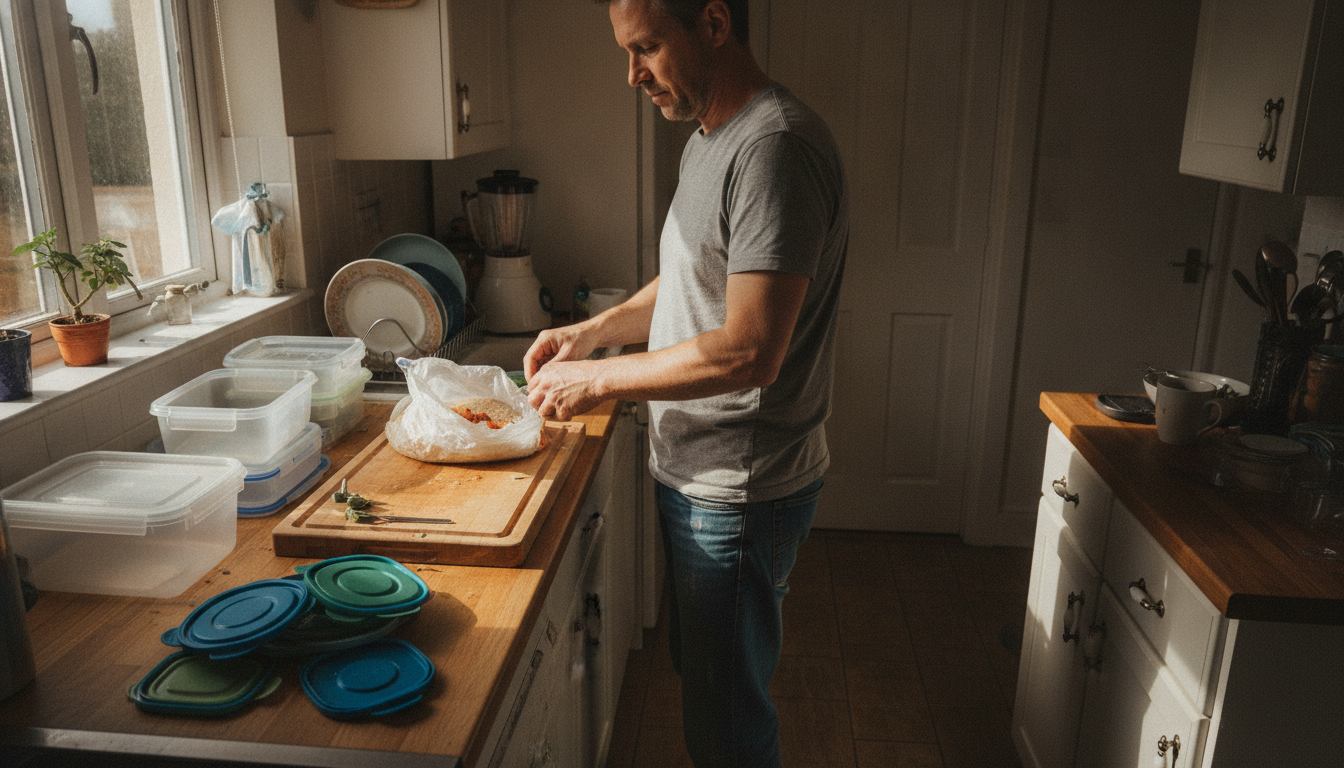
Easy meal prep for dads is one of those phrases that sounds like it was invented by someone who has never had a toddler screaming at their ankles while trying to find the lid to a storage container. We get it. The whole concept can feel like one more optimized lifestyle task that real, tired humans do not actually have bandwidth for. But here is the thing: how you fuel yourself during the week matters more than most dads give it credit for, and a little planning goes a long way.
So we are not going to sell you on a glossy Sunday ritual or a color-coded container system. This is easy meal prep for dads who hate meal prep, meaning we are building the smallest viable system that gets you eating well without turning your weekend into a second job.
Why Dads Specifically Are Getting This Wrong
The data on how people eat when they are stressed is not flattering. A survey of 800 U.S. adults taken in June 2020, during the COVID-19 pandemic, and published in Nutrients found that people with higher perceived stress put more weight on convenience, mood, price, and familiarity when choosing food, and that emotional eating helped explain those links (Shen et al., 2020). That was a one-time snapshot of the general population during an unusual period, not a study of dads, but the pattern will sound familiar to anyone running on five hours of sleep with a fifteen-minute lunch break. In that state the drive-through wins by default, and the reason is not a lack of discipline but a system that is set up to produce that outcome.
The solution is not willpower. It is friction reduction. You make the healthy option the path of least resistance, and then you stop thinking about it. That is the entire philosophy behind the system we are laying out here.
The Minimum Effective Dose of Meal Prep
Most meal prep content is built around maximizing output: twelve meals, four proteins, six containers of overnight oats, a spreadsheet. That approach collapses for busy parents within about two weeks because the upfront investment is too high relative to what the average dad can realistically commit on a Saturday afternoon. What we are proposing instead is the minimum effective dose, which in this context means prepping only the components that solve your highest-frequency problems.
For most dads, those problems are lunch at work and dinner on weeknights after 6pm. Breakfast is usually handled because it is low stakes: eggs, toast, yogurt, whatever. It is the midday and evening meals where the wheels come off. So that is where we focus.
The Three Component Framework
Instead of prepping full meals, prep three categories of components and let them combine freely across the week. The categories are a bulk protein, a bulk carbohydrate, and a set of ready-to-eat vegetables. That is it. Three things, cooked in whatever overlapping batches make sense, and you have the raw material for a dozen different meals without committing to eating the same container of chicken and rice every single day like you are training for a bodybuilding competition.
The reason this works is flexibility. When Tuesday dinner needs to be on the table in twenty minutes, you are pulling pre-cooked components and assembling rather than cooking from scratch. When your lunch on Wednesday needs to not look pathetic in front of your coworkers, you build a grain bowl that looks intentional. Same ingredients, different configuration, zero extra prep time mid-week.
Building the Bulk Protein
Protein is where most easy meal prep for dads advice goes immediately wrong by suggesting you bake twelve chicken breasts in a single pan and call it a week. Baked chicken breast by day three is punishment food, and you will abandon the whole system rather than eat it. Instead, choose one protein per week that is genuinely versatile, meaning it works hot and cold, in multiple flavor contexts, and does not become depressing on day four.
Ground beef or turkey cooked plain with salt and garlic is one of the best options because it absorbs whatever flavors you add at serving time: taco seasoning, soy sauce, tomato, whatever direction you want to go. A large batch of hard-boiled eggs is a no-cook adjacent option that takes twelve minutes. Shredded chicken thighs from a slow cooker on Saturday require almost no active time and stay moist and usable for days. Rotisserie chicken from the grocery store counts as meal prep if you break it down and store it yourself. We are not judging.
Aim for enough protein to cover five to six lunches and two to three dinners. For a single person that might be two pounds of ground meat or two large chicken thigh batches. Scale for however many adults in the household are eating from the same system. One food safety note: cooked meat and poultry leftovers are generally good for three to four days in the fridge, so refrigerate what you need for the first half of the week and freeze the rest in portions you can thaw in the fridge the night before.
Building the Bulk Carbohydrate
The case for a bulk carbohydrate in your easy meal prep for dads system is largely about sustained energy across the workday. In one study, young adults who ate a low-glycemic-index breakfast, one that releases its carbohydrate more slowly, did better on memory tests late in the morning than after a high-glycemic-index breakfast, although the benefit was only loosely related to their blood glucose levels (Benton et al., 2003). That study looked at breakfast and a single morning, so treat it as a hint rather than proof for your lunch. Still, choosing whole grains or legumes over white bread is a sensible bet if you want to give yourself a better shot at getting through the 2pm slump.
The best bulk carbohydrates for this system are ones that reheat well, have a neutral enough flavor to go multiple directions, and hold up in the fridge for a few days without becoming a science experiment. Cool cooked rice and grains quickly and get them into the fridge within a couple of hours of cooking, and freeze any portions you will not eat within three to four days. White or brown rice works. Quinoa works and gives you a bonus protein contribution. Farro is underrated and holds up better in grain bowls than almost anything else. Lentils pull double duty as both carbohydrate and protein source and cost almost nothing per serving.
Cook one big batch on the weekend. A rice cooker with a timer function makes this genuinely hands-off. If you do not own one, a heavy bottomed pot with a lid and a timer on your phone gets you there. The goal is to never be standing in front of a stove waiting for water to boil on a Tuesday night when you are already running on empty.
The Ready-to-Eat Vegetables
This is the category most dads skip, and it is also the one that makes or breaks the nutritional quality of the whole system. Raw vegetables that require washing and cutting in the moment are vegetables that do not get eaten. The solution is to front-load that labor once and make it disappear for the rest of the week.
On the weekend, wash and cut whatever vegetables you are going to use and store them in containers where you can see them in the fridge. Eye level placement matters more than it should. A systematic review of 18 studies found that changing where foods sit, such as the order they are presented in or how close they are to hand, can shift what people choose, although the authors called for better long-term studies (Bucher et al., 2016). Most of that research was not done in home kitchens, but the principle carries over: if the broccoli is already cut and sitting at eye level, you eat it. If it requires excavating the crisper drawer and breaking out the cutting board, you eat chips instead. This is not a character flaw. It is just how decision-making works under cognitive load.
Good options that hold up for four to five days cut: bell peppers, broccoli, cucumber, shredded cabbage or carrot, cherry tomatoes left whole, and roasted vegetables like sweet potato or zucchini. Roasted vegetables do double duty because they work as a side, mixed into bowls, or folded into eggs the next morning.
The Weekend Time Investment: Honest Numbers
Here is what this system actually costs in time, because any easy meal prep for dads guide that refuses to give you real numbers is wasting your time. If you choose one protein, one carbohydrate, and one vegetable prep session, you are looking at somewhere between forty-five minutes and ninety minutes of active and passive time on a weekend, depending on what you pick. Slow cooker chicken plus rice cooker rice plus cutting vegetables is largely parallel work, meaning a lot of that time you are not actually in the kitchen.
Compare that to the time cost of figuring out dinner from scratch five times per week, driving through a fast food line twice, or eating garbage and spending the back half of your workday in a fog. The return on a ninety-minute investment is significant. It is still a ninety-minute investment, and we are not going to pretend otherwise, but in the context of a week it is usually the right trade.
Assembly Logic: How to Eat the Same Ingredients Without Losing Your Mind
The biggest reason meal prep fails for busy parents is flavor monotony. You prep the same thing, it gets boring, you stop reaching for it. The fix is not more variety in what you cook, it is more variety in how you finish the dish at serving time. Keep a small rotation of sauces, dressings, and spice combinations that take thirty seconds to apply and completely transform the flavor profile of the same base components.
A few reliable combinations from the same batch of shredded chicken and rice: add soy sauce, sesame oil, and scallions for an Asian-style bowl; add salsa, lime, and cumin for a taco situation; add olive oil, lemon, and feta for something Mediterranean; serve cold over greens with a vinaigrette for lunch. The base is identical. The eating experience is genuinely different. This is the part that keeps the system running past week two.
Where This Fits in the Bigger Picture of Dad Health
We have talked before about how fatherhood has a way of systematically displacing the habits that used to keep you functional, and the food situation is one of the first things to go. If you are in the thick of early fatherhood, you already know that even basic self-maintenance starts to feel selfish or logistically impossible. It is neither, but it does require intentional architecture rather than willpower. A sustainable meal prep system is part of that architecture.
The identity piece matters too. If you are wrestling with what healthy fatherhood actually looks like in practice rather than on paper, our piece on the new dad identity crisis gets into that territory in a way that might reframe some things. And if you are spending more time at home than you expected and your whole daily rhythm has shifted, Stay at Home Dad in 2026 covers the structural stuff nobody mentions upfront.
The point is that eating well as a dad is not a personal optimization project in isolation. It is connected to your energy, your patience, your capacity to be present, and your long-term health across a period of life that is genuinely demanding. A cross-sectional study of more than 40,000 French adults found that people who planned their meals ahead had better overall diet quality and more food variety, and were less likely to have obesity, than people who did not plan (Ducrot et al., 2017). That design cannot show that planning caused those differences, but it is consistent with everything else here: set up the environment ahead of time and let it do some of the work that willpower usually fails to do.
Common Failure Points and How to Avoid Them
The number one way this system breaks is over-ambition in week one. You decide to prep five things instead of three, spend three hours in the kitchen, feel resentful about it, and never do it again. Start with one protein and one carbohydrate your first week. Add vegetables in week two. Add a second protein option in week three if you want it. Build the habit before you build the volume.
The number two failure point is inadequate containers. Flimsy containers that leak, stack badly, or require hunting for matching lids will erode your willingness to use the system. This does not require a fancy investment, but it does require containers that are all the same size and shape, have secure lids, and are microwave safe. Standardizing on one container format is a small thing that removes a surprising amount of friction. The FoodSafety.gov cold food storage chart is also worth a quick look if you are unsure about fridge life; it lists three to four days for leftover cooked meat or poultry and one week for hard-cooked eggs.
The third failure point is not involving your kids or partner in the system. If you are prepping food that only you eat, you have created a parallel food system in your own household, which adds mental load rather than removing it. Even partial overlap, where the prepped rice becomes a side dish for the family on Tuesday night, makes the system feel less like a solo project and more like a household infrastructure improvement.
The Realistic Goal Line
Nobody is asking you to eat perfectly or to get your food prep featured on a wellness account. The goal of easy meal prep for dads is a lower bar than that and a more useful one: get yourself through the week eating food that actually sustains you, without spending significant mental or physical energy on it in the moment. That is a system, not a lifestyle, and systems are allowed to be unglamorous.
Three components. One session. Some decent containers and a rotation of sauces. That is the whole thing. The research on meal planning and food environments points in the same direction, the logistics support it, and your future Tuesday-evening self, who is tired and hungry and has forty-five minutes before the kids need to be in bed, will have strong feelings about whether past-weekend-self did the prep. Make it easy on him.
References
Benton, D., Ruffin, M.-P., Lassel, T., Nabb, S., Messaoudi, M., Vinoy, S., Desor, D., & Lang, V. (2003). The delivery rate of dietary carbohydrates affects cognitive performance in both rats and humans. Psychopharmacology, 166(1), 86-90. https://doi.org/10.1007/s00213-002-1334-5
Bucher, T., Collins, C., Rollo, M. E., McCaffrey, T. A., De Vlieger, N., Van der Bend, D., Truby, H., & Perez-Cueto, F. J. A. (2016). Nudging consumers towards healthier choices: A systematic review of positional influences on food choice. British Journal of Nutrition, 115(12), 2252-2263. https://doi.org/10.1017/S0007114516001653
Ducrot, P., Méjean, C., Aroumougame, V., Ibanez, G., Allès, B., Kesse-Guyot, E., Hercberg, S., & Péneau, S. (2017). Meal planning is associated with food variety, diet quality and body weight status in a large sample of French adults. International Journal of Behavioral Nutrition and Physical Activity, 14, Article 12. https://doi.org/10.1186/s12966-017-0461-7
Shen, W., Long, L. M., Shih, C.-H., & Ludy, M.-J. (2020). A humanities-based explanation for the effects of emotional eating and perceived stress on food choice motives during the COVID-19 pandemic. Nutrients, 12(9), Article 2712. https://doi.org/10.3390/nu12092712